Adobe Commerce and Magento Open Source run on exactly the same core codebase. They share the same admin panel, the same extension ecosystem, the same upgrade schedule, and the same developer talent pool. A developer experienced on Magento Open Source 2.4.8 can work on Adobe Commerce 2.4.8 without retraining. That shared foundation is precisely why this decision is so easy to get wrong.
The meaningful differences between the two editions are not architectural. They sit in a defined layer of enterprise features added on top of the shared core and a license fee that starts at roughly $22,000 per year (per mgt-commerce.com 2026 pricing analysis). Choosing the wrong side of that line means either overpaying for capabilities your business will never activate, or, alternatively, building on a foundation that cracks under your real requirements and ultimately costs more to fix later than the license would have cost from the start. This guide therefore gives you the full picture — including the honest cases where Magento Open Source is the right answer, which most agency comparisons skip, simply because they only sell one of the two.
| TL;DR — Key Takeaways |
| Both editions share the same codebase, developer pool, and extension ecosystem. The difference is a specific set of enterprise features, a direct support contract, and a license fee — not platform stability or core architecture. |
| Adobe Commerce is the right choice for B2B merchants, multi-brand and multi-region operators, and stores that need native AI search, content staging, company accounts, or negotiable quotes without assembling those capabilities from third-party extensions. |
| Magento Open Source is the right choice for DTC and B2C brands with no meaningful B2B requirements — especially those that want maximum flexibility and do not want to pay for enterprise features they will never use. |
| Adobe Commerce license fees run from roughly $22,000/year at $1M–$5M GMV to $125,000+/year at $25M+ GMV (per a 2026 mgt-commerce.com pricing analysis). These figures are estimates — Adobe negotiates pricing individually, so verify directly. |
| Bemeir is an Adobe Solution Partner and the first and only Hyvä Gold Partner in the USA. We work with merchants on both editions and will give you a straight answer on which fits your situation. |
The table below shows exactly how the two editions relate to each other — what is identical, and where they diverge.
| Adobe Commerce | Magento Open Source | |
| License | Paid — $22,000 to $125,000+ / year (GMV-based, negotiated with Adobe) | Free — no license fee |
| Codebase | Magento 2 core — identical to Open Source | Magento 2 core — identical to Adobe Commerce |
| Admin panel | Same as Open Source | Same as Adobe Commerce |
| Extension ecosystem | Full Magento Marketplace — same as Open Source | Full Magento Marketplace — same as Adobe Commerce |
| Upgrade schedule | Security patches and point releases on same schedule as Open Source | Security patches and point releases on same schedule as Adobe Commerce |
| PHP & stack | PHP 8.3 / 8.4, OpenSearch, MariaDB, Redis — same requirements | PHP 8.3 / 8.4, OpenSearch, MariaDB, Redis — same requirements |
| Hyvä theme | Compatible — B2B module components require compatibility verification | Fully compatible out of the box |
| B2B module | Included natively — company accounts, shared catalogs, negotiable quotes, quick order, purchase orders | Not included — requires third-party extensions or custom development |
| AI search & recommendations | Included — Live Search and Product Recommendations (Adobe Sensei) | Not included — third-party solution required (Algolia, Klevu, etc.) |
| Content staging | Included — full scheduling and auto-rollback | Not available natively |
| Customer segmentation & loyalty | Included — segments, reward points, store credit, gift cards, private sales | Third-party extensions required for each capability |
| Adobe support SLA | Included — direct escalation path to Adobe engineering | Not available |
| Extended security patches | Available for end-of-standard-support release lines (additional cost) | Not available — must upgrade to a supported version |
1. How the Two Editions Are Actually Related
The acquisition that split one platform into two
When Adobe acquired Magento in May 2018, the platform had two publicly available editions: a free open-source download and a paid commercial license. Adobe rebranded the paid edition as Adobe Commerce and the free edition as Magento Open Source. The names changed. The underlying codebase did not.
The shared core both editions run on
Both editions continue to be developed on the same Magento core. Every security patch, every PHP compatibility update, every performance improvement that ships in a new release — 2.4.7, 2.4.8, and the recently released 2.4.9 — applies to both editions simultaneously. Extensions built for one edition run on the other. The open-source developer community contributes to both.
Where the feature layer actually splits
The split happens at the feature layer that Adobe Commerce builds on top of the shared core: a native B2B module, AI-powered search and personalization through Adobe Sensei, full content staging and scheduling, advanced customer segmentation, and a direct support contract with Adobe. That layer has a price. The only question worth answering is whether your business genuinely needs what that price buys.
License versus hosting: a common point of confusion
One clarification that trips up many merchants: Adobe Commerce is a software license, not a hosting arrangement. Adobe Commerce on Cloud Infrastructure — sometimes called Commerce Cloud or Managed Services — is a separate managed hosting product layered on top of the Adobe Commerce license. You can run Adobe Commerce on your own servers, on a managed host such as Nexcess or Hypernode, or on Adobe’s own cloud. This article covers the software edition decision, not the hosting decision.
| The naming confusion — and how to cut through it |
| “Adobe Commerce” = the paid software license (on-premise or self-hosted on any infrastructure). “Adobe Commerce on Cloud” = Adobe Commerce license bundled with Adobe’s managed AWS hosting. “Magento Open Source” = the free, self-hosted edition. “Magento” generically refers to the platform family. When an agency or vendor says “Magento,” ask which edition they mean — the answer matters for scoping and budgeting. |
2. What Both Editions Share
Before covering what separates them, it is worth being explicit about what is identical — because the shared foundation is extensive:
- The full Magento product catalog architecture: configurable products, grouped products, bundle products, virtual products, downloadable products, custom attributes, and multi-source inventory management
- The complete order management system: orders, invoices, shipments, credit memos, returns processing, and order status workflows
- The full checkout pipeline, including Instant Purchase, guest checkout, multi-address shipping, and persistent shopping cart
- Complete access to the Magento Marketplace and any third-party extension — the same extension ecosystem, the same compatibility framework
- The admin panel: same layout, same configuration sections, same import and export tools, same report structure
- Basic Page Builder for building and editing content pages without writing code
- Full-page caching with Varnish, Redis cache support, OpenSearch integration for Magento 2.4.7 and above, and Valkey 8.1 LTS cache backend support
- Support for PHP 8.3 and 8.4 (PHP 8.2 minimum), MariaDB and MySQL, and RabbitMQ 4.2
- The same upgrade path: security patches and point releases ship to both editions on the same schedule
- Full Hyvä theme compatibility on the frontend for both editions
That list is long because it matters. The two editions are far more alike than most comparisons suggest. What Adobe Commerce adds is a specific, well-defined set of capabilities. The question is whether those capabilities are ones your business actually needs.
3. What Adobe Commerce Adds: The Enterprise Feature Layer
Adobe Commerce’s additional capabilities fall into five main categories. Working through each one clearly is the fastest way to evaluate whether the license makes sense for your specific operation.
| Feature Category | What Adobe Commerce Includes | What Magento Open Source Has |
| B2B Module | Company accounts with role-based permissions and spending limitsShared catalogs — different products and pricing per buyer groupNegotiable quotes processed entirely inside MagentoQuick Order by SKU or CSV uploadRequisition lists and purchase order payment on accountApproval workflows and company hierarchy management | Not included. Third-party extensions required — each module carries its own license fee and requires compatibility management across Magento upgrades. |
| AI Search &Personalisation | Live Search — instant AI-ranked results as shoppers typeMerchandising controls (pin, boost, bury) without developer helpProduct Recommendations — ‘Customers also viewed’, ‘Trending’, etc.Both powered by Adobe Sensei AI — no third-party SaaS required | Not included. Third-party solution required — Algolia, Klevu, or Meilisearch. Klevu starts at $649/month (klevu.com/magento-pricing/); Algolia enterprise plans start around $50,000/year (algolia.com/pricing/). Integration development adds to both. |
| ContentManagement | Full content staging — prepare campaigns in advanceScheduled auto-deploy and auto-rollback — no developer ticketsDynamic blocks — show different content to different segmentsEnhanced Page Builder with full page hierarchy | Basic Page Builder included. Full content staging and scheduling not available natively — no practical third-party substitute that survives Magento upgrades. |
| Loyalty &Segmentation | Customer segmentation by purchase history, cart, location, and valueReward points, store credit, and gift cards — all nativeGift registries and private sales events with countdown timersDynamic pricing and promotions per customer segment | Not included natively. Each capability — reward points, store credit, gift cards, private sales — requires a separate third-party extension. |
| EnterpriseSupport | Adobe technical support SLA with defined response timesEscalation path to Adobe engineering for platform-level issuesPre-release security patch access before public releaseExtended security patches for older release lines after standard EOS | No Adobe support contract available. Community-supported only. End-of-support versions receive no further patches — upgrade required to restore coverage. |
B2B commerce module
This is the most meaningful differentiator for the majority of merchants making this decision. The Adobe Commerce B2B module is a native, tightly integrated set of tools for selling to businesses rather than individual consumers. It was designed by Adobe specifically for manufacturers, distributors, wholesalers, and any merchant whose buyers expect account-level commercial relationships rather than consumer checkout flows.
The B2B module includes:
- Company accounts with role-based permissions: A buyer creates or joins a company account. The company administrator adds sub-users, defines roles (purchasing agent, manager, viewer), and sets spending limits per role. Multiple buyers from the same organization operate under one account without sharing credentials.
- Approval workflows: Orders above a defined threshold require approval from a manager before they process. This mirrors standard corporate purchasing controls and eliminates the need for a separate procurement tool for most mid-market B2B operations.
- Shared catalogs: Different customer groups see different product selections and pricing. A distributor sees wholesale pricing; a retail buyer sees MSRP; a government buyer sees a contract-specific SKU list. All managed from the admin without custom development.
- Negotiable quotes: A buyer requests a quote directly from the storefront. The sales rep reviews and responds from within the Magento admin — adjusting line-item prices, adding notes, setting expiry dates. The buyer accepts, rejects, or counters. The entire negotiation lives in the platform. No separate quoting tool required.
- Requisition lists: Saved order templates that repeat buyers use to repopulate their cart. A procurement manager buying the same 40 SKUs every two weeks does it in seconds, not minutes.
- Quick Order by SKU or CSV: Buyers paste a CSV of SKU numbers and quantities to populate the cart instantly. This is table stakes for any manufacturer or distributor whose buyers reorder predictable SKU sets.
- Purchase orders and payment on account: Buyers place orders against a company credit line and settle on agreed terms (net-30, net-60). Eliminates the need for a separate invoicing or credit management tool for most mid-market B2B operations.
- Multi-company management: Administrators can manage multiple companies from a single account using the storefront company switcher, supporting parent-child account structures for businesses with subsidiaries or regional operating companies.
None of these features exist in Magento Open Source. They can be approximated with third-party extensions — vendors including Amasty, Mageworx, and specialized B2B extension providers offer modules for some of these functions. But assembling an equivalent B2B stack from extensions means evaluating compatibility, paying ongoing extension license fees and maintaining that stack across every Magento upgrade. For merchants whose core business model is B2B, the native Adobe Commerce module is almost always the cheaper and more reliable approach.
How the negotiable quote workflow works in practice
The following table shows how a B2B negotiable quote moves from buyer request to placed order — entirely inside Adobe Commerce, without a separate quoting tool, CRM, or email thread.
| Step | Who Acts | What Happens | Where It Happens |
| 1 — Request | Buyer | Buyer logs in to their company account and clicks “Request a Quote” from any product or cart page. | Magento storefront — no external form or tool |
| 2 — Review | Sales rep | Sales rep opens the quote in the Magento admin. Reviews line items, buyer history, and margin. Can see the buyer’s company credit status. | Magento admin panel |
| 3 — Negotiate | Both | Rep adjusts prices per line item, adds notes, and sets an expiry date. Buyer receives a notification, can counter-offer or ask questions. All in-platform. | Admin (rep) + storefront (buyer) |
| 4 — Accept | Buyer | Buyer accepts the quote. Cart is automatically populated with the agreed prices. Standard checkout proceeds. | Magento storefront |
| 5 — Order Placed | System | Order is placed and processed. If the company uses payment on account (net-30 / net-60), no payment gateway is involved at checkout. | Magento order management |
Note: This entire workflow runs natively in Adobe Commerce. Magento Open Source does not include a negotiable quote module. Replicating it with third-party extensions requires careful compatibility evaluation and adds ongoing maintenance cost.
Live Search and AI-powered product recommendations
Adobe Commerce includes Live Search, an AI-powered search layer built on Adobe Sensei. It delivers instant, relevance-ranked results as a shopper types — not on submit — with synonym management, faceted filtering, and merchandising controls (pinning specific products to the top, boosting a category, burying out-of-stock items) that merchandisers operate without developer involvement. The model learns from behavioral data: what shoppers click, what they purchase, and what they ignore after searching. Over time, result quality improves without manual tuning.
Adobe Commerce also includes Product Recommendations, a native AI recommendation engine that powers units like “Customers also viewed,” “More like this,” “Trending,” and “Recently viewed” across the storefront. Both tools use the same Adobe Sensei model and require no third-party SaaS subscription.
On Magento Open Source, equivalent functionality requires a paid third-party solution. Algolia, Klevu, and Meilisearch are the most common choices for search. Each works well, but each adds meaningful annual cost: Klevu starts at $649/month (klevu.com/magento-pricing/), and Algolia enterprise plans begin around $50,000/year (algolia.com/pricing/). Integration development and an independent maintenance track run on top of those figures.
Advanced content management: staging and scheduling
Adobe Commerce includes a full content staging system. Merchandisers can prepare a promotional campaign — a sale banner, a category page redesign, a targeted price rule — schedule it to go live at a specific time, and schedule it to roll back at the end of the promotion period. All from the admin, without developer tickets.
The practical impact: a merchandising team prepares the Black Friday sale in October, schedules it for midnight on the correct date, and has it revert automatically 72 hours later. No late-night deployment. No risk of forgetting to roll back a price change. For teams running frequent, time-sensitive campaigns, content staging is not a convenience feature — it is infrastructure for how the business operates.
Magento Open Source includes a basic version of Page Builder for content creation, but the full content staging and scheduling system is an Adobe Commerce exclusive. Atwix, one of the more rigorous Magento agencies, notes that Page Builder and Content Staging are “nearly impossible to replace” with third-party extensions when factoring in upgrade and migration effort. This is one of the Adobe Commerce features with the highest practical value for retail merchandising teams and the lowest viable substitute.
Customer segmentation, loyalty, and personalization
Adobe Commerce includes native customer segmentation — the ability to define audiences based on purchase history, cart contents, geographic location, lifetime value, and customer attributes — then target those segments with different pricing tiers, promotions, and content. This connects directly to Dynamic Blocks, which lets merchandisers display different banners and content modules to different segments without requiring a CMS integration or developer work.
Also native to Adobe Commerce: Reward Points (a loyalty currency customers earn and redeem), Store Credit (refunds that stay on the account for future orders), Gift Cards, Gift Registries, Private Sales and Events (invitation-only sale pages with countdown timers), and Email Reminders for abandoned carts and wish lists. These are standard loyalty and promotional mechanics that eCommerce brands build for. On Magento Open Source, each requires a separate extension.
Adobe Experience Cloud integration and enterprise support
Adobe Commerce connects natively to Adobe Experience Manager for headless content management, Adobe Analytics for behavioral and revenue reporting, Adobe Target for A/B testing and personalization, and Adobe Real-Time CDP for unified customer data. For merchants already operating within the Adobe ecosystem, native integration reduces implementation scope and gives marketing, commerce, and analytics teams a shared data layer.
For merchants not on the Adobe ecosystem, this is not a meaningful differentiator. The connectors are included in the license; the Adobe Experience Cloud products themselves are not.
Adobe Commerce also includes access to Adobe’s technical support team under a defined SLA, including pre-release patch access and escalation paths to Adobe’s engineering team. For a store processing $50M+ in annual GMV, having that escalation path during peak season has genuine risk-reduction value. Adobe also offers extended security patch support for older Adobe Commerce release lines after their standard end-of-support date. Magento Open Source merchants on an end-of-life version have no equivalent option and must upgrade to restore security coverage.
4. The Full Cost Comparison
Cost is where most merchants make the wrong decision, in both directions. Some over-buy Adobe Commerce for a store that would run perfectly well on Open Source. Others build on Open Source because the license is free and then spend more in extension licenses, integration development, and maintenance than the Adobe Commerce license would have cost.
Adobe Commerce license pricing
Adobe Commerce license fees are negotiated with Adobe and tied to annual GMV. Published pricing analysis by mgt-commerce.com (2026) indicates the following approximate ranges for the on-premise license. These are estimates, not official Adobe pricing — verify current terms directly with Adobe or through Bemeir as an Adobe Solution Partner:
| Annual GMV | Approx. On-Prem License/Year | Approx. Cloud License/Year |
| $1M – $5M | ~$22,000 | ~$40,000 – $48,000 |
| $5M – $10M | ~$32,000 | ~$58,000 – $70,000 |
| $10M – $25M | ~$50,000 | ~$90,000 – $110,000 |
| $25M+ | $125,000+ | $225,000+ |
Source: mgt-commerce.com 2026 Adobe Commerce pricing analysis. All figures are estimates. Adobe negotiates pricing individually.
Total cost of ownership: both platforms in full
The license fee is one input. A realistic TCO comparison includes hosting, development, extensions, and ongoing maintenance. Scandiweb’s 2026 agency analysis notes that total all-in annual costs for Adobe Commerce typically run 2–3 times the license fee, putting realistic operating costs for a $5M–$25M GMV store in the $120,000–$450,000/year range.
| Cost Category | Adobe Commerce | Magento Open Source |
| License | $22,000–$125,000+/year | Free |
| Hosting | Varies by host and infrastructure tier | Varies by host and infrastructure tier (same range as Adobe Commerce) |
| B2B features | Included natively in license | Third-party extension licenses required — each B2B capability needs a separate module |
| AI search & recommendations | Included (Live Search + Product Recs) | $7,800+/year for Klevu (klevu.com/magento-pricing/) or ~$50,000/year for Algolia enterprise (algolia.com/pricing/), plus integration dev |
| Content staging & scheduling | Included natively | Not replicable — unavailable natively |
| Customer segmentation & loyalty | Included natively | Third-party extension required for each capability |
| Adobe technical support SLA | Included | Not available |
| Extended security patches | Available (additional cost) | Not available |
| Initial build cost | Varies significantly by store complexity, extension count, and design scope — contact Bemeir for a scoped estimate | Varies significantly by store complexity, extension count, and design scope — contact Bemeir for a scoped estimate |
Initial build costs vary significantly based on store complexity, extension count, and design scope. Contact Bemeir for a scoped estimate.
| The honest cost conclusion |
| For a B2B merchant that genuinely needs company accounts, shared catalogs, negotiable quotes, and AI-powered search, the Adobe Commerce license often costs less than assembling equivalent functionality from third-party extensions — once extension licenses, integration development, and ongoing maintenance are counted. For a DTC brand with no B2B requirements, no need for content staging, and no use for AI personalization, the license fee is very hard to justify. Magento Open Source with a Hyvä frontend typically delivers better performance at meaningfully lower total cost for that use case. |
5. Side-by-Side Feature Comparison
| Feature | Adobe Commerce | Magento Open Source |
| Shared codebase & upgrade schedule | Yes | Yes |
| Full extension marketplace access | Yes | Yes |
| Page Builder | Full version — enhanced features | Basic version included |
| Content staging & scheduling | Yes — native | No — not available natively |
| B2B: company accounts, shared catalogs, quotes | Yes — native module | No — 3rd-party or custom dev required |
| Negotiable quotes & purchase orders | Yes — native | No |
| Quick Order by SKU / CSV | Yes — native | No |
| Requisition lists | Yes — native | No |
| Live Search (AI-powered, Adobe Sensei) | Yes — included | No — 3rd-party solution required |
| Product Recommendations (AI) | Yes — included | No — 3rd-party solution required |
| Customer segmentation | Yes — native | Limited — 3rd-party for full capability |
| Dynamic blocks / personalized content banners | Yes — native | No |
| Reward points | Yes — native | 3rd-party extension required |
| Store credit | Yes — native | 3rd-party extension required |
| Gift cards | Yes — native | 3rd-party extension required |
| Gift registry | Yes — native | No |
| Private sales & events | Yes — native | No |
| RMA and returns management | Yes — native | 3rd-party extension required |
| Order archive | Yes — native | No |
| Adobe Experience Cloud integration | Native connectors included | Custom connectors required |
| Adobe technical support (SLA) | Included in license | Not available |
| Extended security patches for older release lines | Available (additional cost) | Not available |
| Hyvä theme compatibility | Yes (B2B module needs verification) | Yes — full compatibility |
| License cost | $22,000–$125,000+/year | Free |
6. When to Choose Each Edition
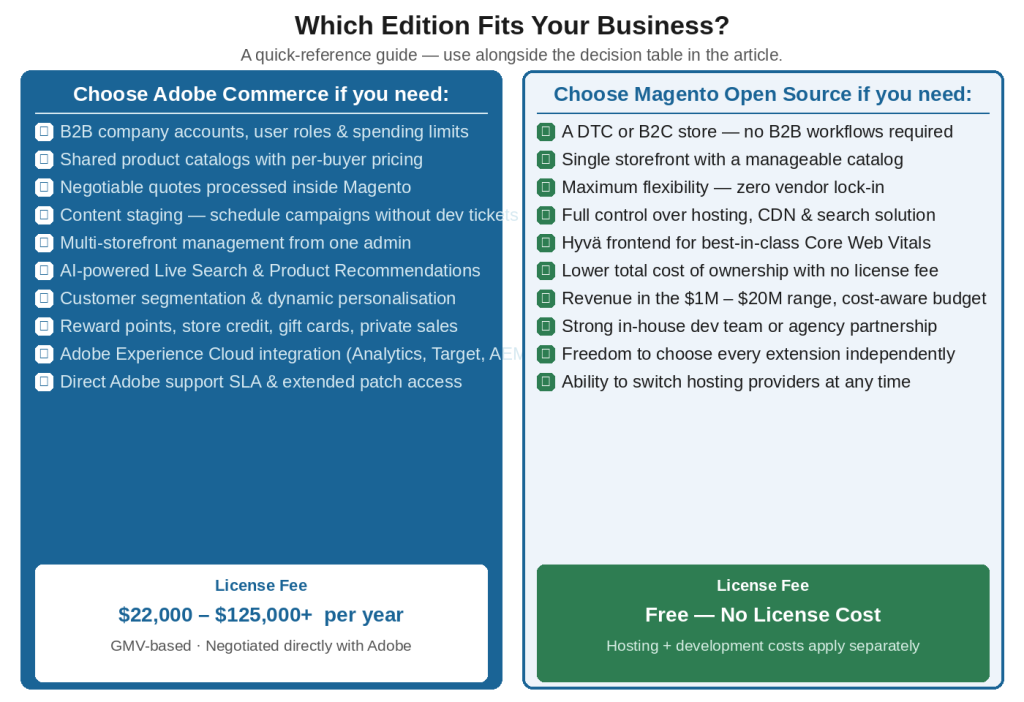
Adobe Commerce: the right fit when one or more of the following applies
When Adobe Commerce makes sense
The chart above gives a quick-reference overview. The points below explain the reasoning behind each scenario in more detail.
AI-driven search and personalization without a separate SaaS. Live Search and Product Recommendations are included in the Adobe Commerce license. For stores where search relevance and recommendation quality are competitive differentiators, having them native to the platform — maintained by Adobe, not a third-party vendor — simplifies both the vendor stack and upgrade planning.
B2B or hybrid B2B/B2C business model. You sell to companies, not just individual consumers. Buyers expect account-level pricing, purchase approval workflows, and the ability to negotiate order values. Building those capabilities from extensions on Open Source costs more and breaks more often than the native Adobe Commerce B2B module.
Multiple storefronts from a single installation. Multiple brands, regions, or currencies managed from one admin. Adobe Commerce’s multi-site architecture combined with content staging lets a lean merchandising team manage what would otherwise require parallel development efforts across separate codebases.
Frequent, time-sensitive promotional campaigns. If your team schedules sale events, promotional landing pages, or pricing changes in advance and expects them to go live and roll back automatically — without developer tickets — content staging is central to your operation, not optional.
Existing investment in Adobe Experience Cloud. If Adobe Analytics, Adobe Target, or Adobe Experience Manager are already in your stack, native integration reduces development cost and gives your teams a unified customer data layer.
High GMV with a need for a support backstop. For operations processing over $10M in annual GMV, Adobe’s support SLA has genuine value — particularly during peak periods when a platform-level issue needs escalation beyond community forums and documentation.
Proof in production: SD Bullion
Bemeir’s client SD Bullion — a $1B GMV precious metals retailer — operates on Adobe Commerce. The platform’s ability to handle complex real-time pricing rules, high-volume catalog management, and a high-stakes checkout experience was central to the fit. The Adobe Commerce B2B module also supports wholesale dealer relationships that sit alongside the consumer storefront. For an operation of that complexity, the license cost is a small fraction of the avoided custom development expense.
Magento Open Source: the right fit when one or more of the following applies
Magento Open Source is the right platform when:
- Your business model is DTC or B2C with no meaningful B2B requirements. You sell to individual consumers. Buyers do not need company accounts, shared catalogs, purchase approval workflows, or negotiated quotes. The entire B2B module is irrelevant to your operation. You should not pay for it.
- You want maximum customization flexibility without vendor constraints. Open Source imposes no vendor lock-in beyond the Magento framework itself. You choose your hosting, your extensions, your CDN, your search solution, and your support arrangement. For technically confident teams, that freedom is a genuine advantage.
- Budget is a genuine constraint and you have development capability. Open Source has no license fee. A well-built Open Source store with Hyvä on the frontend can deliver faster performance than most Adobe Commerce stores running Luma, at meaningfully lower total cost.
- You are a mid-market DTC brand generating $1M–$20M in annual revenue. At this revenue level, the Adobe Commerce license represents a meaningful percentage of your total platform budget. Magento Open Source with thoughtfully chosen extensions often delivers comparable outcomes at significantly lower total cost of ownership — for merchants who do not need the enterprise feature layer.
- You have in-house development capability or a strong agency relationship. Magento Open Source does not include a support contract. If your team is not equipped to handle platform-level issues — security patches, infrastructure failures, extension conflicts — the absence of Adobe support is a real operational risk, not just a line item comparison.
| The most common misconception about Magento Open Source |
| Magento Open Source is not a starter platform for small stores. Large, high-volume DTC and B2C operations — processing tens of millions of dollars annually — run on Magento Open Source without performance or scalability issues. The decision should be driven by business model requirements, not by revenue or ambition. Choosing Adobe Commerce because it sounds more “enterprise” and then never activating the B2B module or content staging is one of the most predictable ways to overspend on a Magento implementation. |
7. Technical Requirements: What Both Platforms Need
Both editions share the same technical stack requirements at the current release. As of June 2026, Magento 2.4.8 is the current stable release, with Magento 2.4.9 having reached general availability in May 2026.
| Technology | Supported Versions | Notes |
| PHP | 8.3 or 8.4 (8.2 minimum) | PHP 8.1 is end of life — not supported on any current release |
| Search engine | OpenSearch 2.x or 3.x | Elasticsearch is no longer the default for 2.4.7+ |
| Database | MariaDB 10.6–11.4, MySQL 8.0 | MySQL 8.0 EOS begins April 30, 2026 |
| Cache backend | Redis or Valkey 8.1 LTS | Valkey is now supported on cloud infrastructure |
| Message queue | RabbitMQ 4.2 | RabbitMQ 4.1 reached EOS February 2026 |
| Web server | Nginx (recommended) or Apache 2.4 | Nginx is standard for production |
| Full-page cache | Varnish 7.x | Fastly used on cloud infrastructure deployments |
A note on Hyvä compatibility: Bemeir is the first and only Hyvä Gold Partner in the USA, which means we implement Hyvä on both editions regularly. Hyvä is fully compatible with Magento Open Source. On Adobe Commerce, the Hyvä core theme works on the frontend, but the B2B module’s storefront components — company account pages, negotiable quote flows, and requisition list interfaces — require explicit compatibility verification. This is manageable in every project, but it needs to be scoped during discovery. See bemeir.com/hyva/ for Hyvä implementation and migration services.
8. Five Things Worth Understanding Clearly
Platform selection decisions go wrong when they are based on surface-level assumptions rather than what each edition actually does. Here are five points that are worth understanding clearly before making the call:
Store size does not determine which edition you need
Both Vaimo and BelVG — two agencies with deep Magento track records — explicitly note that revenue is a poor filter for this decision. Large, high-volume DTC operations run on Magento Open Source without performance or scalability issues. BelVG’s 2026 comparison observes that assuming Adobe Commerce is only for enterprise brands and Magento Open Source is for mid-sized stores will actively mislead you. Scalability is a function of infrastructure and implementation quality, not edition.
The license cost gap narrows quickly once extensions are counted
Magento Open Source carries no license fee. But a B2B merchant who builds on Open Source and then assembles B2B capabilities from third-party extensions — paying module license fees, integration development, and ongoing maintenance — has not necessarily saved money compared to Adobe Commerce. The license saving holds when you genuinely do not need the features the Adobe Commerce license includes. When you do need them, the build-it-yourself path frequently costs more.
Platform edition and storefront performance are independent variables
Choosing Adobe Commerce does not mean choosing a faster store. Performance is determined by hosting configuration, caching architecture, frontend quality, database tuning, and extension quality — all of which apply equally to both editions. A Magento Open Source store built on Hyvä and properly configured infrastructure will consistently outperform an Adobe Commerce store running the default Luma theme on the same hardware. If frontend performance is the primary goal, the frontend and infrastructure investment is what moves the needle, regardless of edition.
Re-platforming entirely is worth evaluating for some businesses
For DTC brands under $10M in annual revenue with a straightforward catalog and no B2B requirements, Shopify Plus offers meaningfully lower total cost of ownership, faster time-to-market, and a smaller operational footprint than either Magento edition. Its B2B capabilities have expanded substantially. The right question to ask is whether Magento’s flexibility and feature depth are required by your specific business model — or whether a simpler SaaS platform would deliver the outcome with less overhead. Bemeir will tell you honestly if that is the case.
Extension quality risk applies equally to both editions — manage it deliberately
Both editions use the same extension framework, which means both carry the same extension quality risks. A poorly coded module can degrade performance, introduce security vulnerabilities, or conflict with other extensions regardless of which edition you run. Atwix correctly notes that third-party extensions often risk store performance and that extension code should be reviewed before installation. Adobe Commerce’s native feature set reduces the number of extensions required — which reduces risk — but does not eliminate it.
9. The Decision Framework
Work through the three questions below in order. Stop at the first question where you answer Yes — that is your edition. If you answer No to all three, Magento Open Source is the right fit.
| Step | Question | If Yes: choose this edition |
| 1 | Does your business sell to other businesses (B2B)?Do buyers need company accounts, role-based permissions, shared catalogs, negotiable quotes, requisition lists, or purchase-order payment? | Adobe CommerceThe native B2B module delivers every one of those capabilities without third-party extensions. Building an equivalent stack on Open Source costs more and is harder to maintain across upgrades. |
| 2 | Does your merchandising team need to schedule content or manage multiple storefronts?Do they need to prepare campaigns in advance, schedule them to go live at a specific time, and roll them back automatically — without raising a developer ticket? | Adobe CommerceContent staging and scheduling is an Adobe Commerce exclusive. It cannot be replicated natively on Magento Open Source and is extremely difficult to replace with third-party tools across upgrades. |
| 3 | Is your annual GMV over $10M and do you need a direct Adobe support SLA?Does having an escalation path to Adobe’s engineering team — during a platform-level incident at peak season — represent genuine risk-reduction value for your business? | Adobe CommerceThe support SLA, pre-release patch access, and extended security patch availability are exclusive to Adobe Commerce. For high-GMV stores, these carry real operational value. |
| — | You answered No to all three questions above.Your requirements do not call for the enterprise feature layer that Adobe Commerce adds. A well-built Magento Open Source store is the right foundation. | Magento Open SourceNo license fee. Full platform flexibility. With Hyvä on the frontend and a well-configured hosting stack, it delivers enterprise-level performance without the enterprise license cost. |
Work through these questions against your actual business requirements. The pattern of answers is more reliable than any feature list:
| Question | Points to Adobe Commerce | Points to Open Source |
| Do you sell to businesses, not just consumers? | Yes | No |
| Do buyers need company accounts, approval workflows, or negotiated pricing? | Yes | No |
| Do you operate more than one storefront from a single admin? | Yes | No |
| Does your merchandising team schedule promotions without developer help? | Yes | No |
| Are you already using Adobe Analytics, Adobe Target, or AEM? | Yes | No |
| Is your annual GMV over $10M? | Yes | No |
| Do you need a direct vendor support contract as a risk backstop? | Yes | No |
| Is the license fee a meaningful constraint on your platform budget? | No | Yes |
If you answered yes to four or more of the first seven questions, Adobe Commerce is almost certainly the right fit. However, if you answered no to most of the first seven — and yes to the last one — Magento Open Source deserves serious consideration.
In case all the answers are mixed, the right next step is a proper discovery conversation, not another comparison article. See bemeir.com/magento/ for Bemeir’s Magento advisory and implementation services on both editions.
10. Frequently Asked Questions
Is Adobe Commerce worth the license cost?
It depends entirely on which features you use. For B2B merchants, the native B2B module, shared catalog management, and negotiable quotes, in fact, often end up costing less than assembling equivalent functionality from third-party extensions — particularly once extension licenses, integration development, and, ultimately, ongoing maintenance are factored in. For DTC brands with no B2B requirements and no need for content staging or AI personalization, the license is very hard to justify. The answer depends on your specific feature usage, not on your revenue.
Can I start on Magento Open Source and switch to Adobe Commerce later?
Yes. Because both editions share the same codebase, switching from Open Source to Adobe Commerce is far simpler than a full platform migration to a different system. The process involves obtaining the Adobe Commerce license, enabling the additional feature modules, and configuring them. Extensions and custom code carry over. For most stores, this can be completed in weeks. Starting on Open Source and upgrading later is a legitimate strategy, particularly for merchants whose B2B requirements are expected to grow.
Does Adobe Commerce include hosting?
Not by default. Adobe Commerce is a software license. You choose your own hosting: a managed Magento host (Nexcess, Hypernode, Cloudways), a general cloud provider, or Adobe’s own managed infrastructure. Adobe Commerce on Cloud is a separate product that bundles the license with Adobe-managed AWS hosting, Fastly CDN, New Relic monitoring, and automated patching. The cloud option typically costs 1.8–2.2 times the on-premise license fee according to mgt-commerce.com‘s 2026 analysis.
Does Magento Open Source receive security patches?
Yes. Security patches for Magento Open Source ship on the same schedule as Adobe Commerce for all currently supported release lines. The difference is that Adobe Commerce customers can purchase extended support for older release lines after their standard end-of-support date. Magento Open Source merchants on an end-of-life version receive no further official patches and must upgrade to restore security coverage.
Is Hyvä available on Adobe Commerce?
Yes. Hyvä is a frontend theme that runs on top of Magento 2 and is compatible with both editions. On Adobe Commerce, the Hyvä core theme and most storefront functionality works without modification. The Adobe Commerce B2B module’s storefront components require compatibility verification against Hyvä’s current compatibility matrix. Bemeir — the first and only Hyvä Gold Partner in the USA — assesses and manages this as part of every Hyvä migration project. See bemeir.com/hyva/ for details.
What PHP version does Magento 2.4.8 require?
Magento 2.4.8 requires PHP 8.3 or 8.4, with PHP 8.2 as the minimum for existing installations. PHP 8.1 reached end of life and is not supported on any current Magento release — any store still running it should upgrade immediately. OpenSearch is the required search engine for Magento 2.4.7 and above — Elasticsearch is no longer the recommended solution for current releases.
| Not Sure Which Edition Fits Your Business? |
| Bemeir is an Adobe Solution Partner and the first and only Hyvä Gold Partner in the USA. |
| We work on both editions and will give you a straight answer — not a pitch. |
| Schedule a 30-minute discovery call — or request a free site speed audit. |
| bemeir.com/magento/ • bemeir.com/hyva/ • (212) 401-1969 |