
Choosing the right Magento agency can determine whether your eCommerce business scales efficiently or struggles with costly delays, technical debt, and poor performance. This guide breaks down the seven most important questions every business should ask before hiring a Magento or Adobe Commerce partner — from certifications, Hyvä expertise, and custom development standards to integrations, project management, security, pricing transparency, and post-launch support. Whether you’re planning a new Magento build, a migration, or a long-term growth strategy, this article will help you evaluate agencies with confidence, avoid common red flags, and choose a partner capable of delivering long-term eCommerce success.

At Bemeir, we’ve worked inside the Magento and Adobe Commerce ecosystem for years as an Adobe Solution Partner. We also hold Hyvä Gold Partner status — one of a select group of agencies globally recognized for proven expertise in the Hyvä frontend framework, which represents the next generation of Magento storefront performance. We’ve seen what great agency partnerships look like, and we’ve watched businesses recover from bad ones.
This guide walks you through everything you need to ask, evaluate, and verify before committing to a Magento agency.
Why This Decision Matters More Than You Think
Most merchants understand that building on Magento requires professional expertise. What’s less appreciated is how much the quality of that expertise varies — and how difficult it is to course-correct once development is underway.
Consider the typical consequences of choosing the wrong agency:
- Technical debt — Poorly written code that works initially but becomes increasingly expensive to maintain, customize, or upgrade
- Integration failures — Systems that don’t communicate reliably, causing order errors, inventory discrepancies, and customer data loss
- Security vulnerabilities — Unpatched systems or misconfigured access controls that expose your store and your customers
- Scope creep and cost overruns — Vague contracts that leave budget boundaries undefined
- Missed deadlines — Launches delayed by weeks or months, costing revenue and market timing
- Post-launch abandonment — Agencies that deliver a project and disappear, leaving you without support when problems emerge
Before You Start: Get Your Own House in Order
Before reaching out to a single agency, you need clarity on your own requirements. A well-defined project scope helps you quickly filter out unsuitable agencies and identify those genuinely capable of delivering what you need.

1. Define Your Goals with Specificity
Don’t just say “increase sales.” Real goals are specific, measurable, and tied to business outcomes. For example:
- Increase online sales by 30% within 12 months of launch
- Reduce cart abandonment rate from 72% to 57% within six months
- Migrate from Magento 1 to Adobe Commerce with zero order data loss and less than 4 hours of downtime
- Achieve Core Web Vitals scores of 90+ on mobile within three months of launch
- Expand into European markets within 18 months, with localized pricing and tax compliance
2. Make a Detailed Requirements Document
Document everything before you contact anyone. Include:
- Brand and design: Brand guidelines, example aesthetics, existing design assets
- Functional requirements: Core features for launch, desirable features, back-end workflows (order management, returns, inventory)
- Technical requirements: Current platform, migration requirements, performance benchmarks, coding standards
- Integration requirements: ERP (SAP, Sage, Khaos Control, NetSuite), CRM (Salesforce, HubSpot), payment gateways, shipping carriers, marketing automation, marketplace management (Amazon, eBay), B2B procurement systems
- Compliance requirements: GDPR (EU markets), PCI-DSS (payment processing), WCAG 2.1 accessibility, industry-specific regulations
3. Set a Realistic Budget
Magento development ranges from $25,000 for a basic implementation to $125,000+ for a highly customized enterprise store. Budget for all cost components:
| Cost Component | Typical Range |
| Magento Open Source license | Free |
| Adobe Commerce license | $50,000+/year (based on GMV/AOV) |
| Hosting (cloud/VPS/dedicated) | Varies by traffic and infrastructure needs |
| Domain registration | $10–$400/year |
| SSL certificate | $50–$300/year |
| Third-party modules/extensions | $60–$600/year per module |
| Payment gateway fees | ~2.9% per transaction + $0.30 fixed (varies by provider) |
| Development and design | Varies by scope and customization level |
| Post-launch support and maintenance | Ongoing — factor into total cost of ownership |
Rule of thumb: Invest at least 5% of your projected annual online revenue into your eCommerce platform. Always build a contingency buffer of at least 20% — unexpected costs are the norm, not the exception.
4. Decide on Your Preferred Agency Model
| Model | Advantages | Considerations |
| Onshore (same country) | Cultural alignment, time zone convenience, easier in-person collaboration | Typically higher hourly rates |
| Nearshore (nearby countries) | Good cost/communication balance, overlapping working hours | Minor cultural differences |
| Offshore (different region) | Potentially lower development costs | Time zone gaps, language barriers, requires more structured communication protocols |
The 7 Questions to Ask Every Magento Agency
Question 1: Are You an Adobe Solution Partner — and What Other Certifications Do You Hold?
This is your first filter and one of the most objective data points available. Adobe’s Solution Partner program certifies agencies that have met specific requirements across technical expertise, client project volume, and ongoing training. To earn and maintain partner status, agencies must:
- Employ a minimum number of Adobe-certified developers
- Complete required Business Compliance Training
- Deliver a minimum number of high-quality Magento projects annually
- Maintain ongoing education through Adobe/Magento training programs
Adobe Solution Partner Tiers
| Partner Level | What It Signals |
| Global Elite | Exceptional scale, expertise, and client outcomes — the highest designation |
| Platinum | Advanced capabilities across large-scale, complex projects |
| Gold | Demonstrated track record and significant technical depth |
| Silver | Meaningful, sustained investment in platform expertise |
| Bronze / Community | Entry-level recognition |
Why Hyvä Partnership Matters
Beyond Adobe Solution Partner status, ask whether the agency is a certified Hyvä partner. Hyvä is the modern frontend framework for Magento 2 that replaces the legacy Luma theme — and the performance difference is transformative.
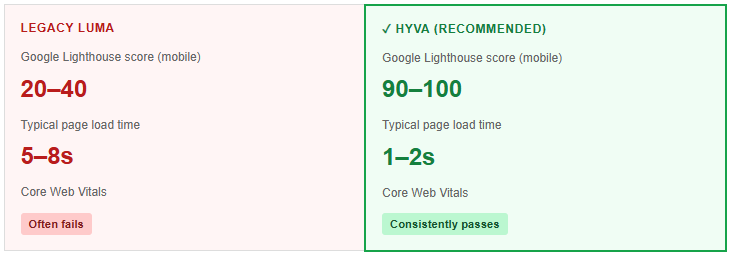
Core Web Vitals directly affect Google search rankings. Faster stores convert more — especially on mobile.
Hyvä has its own tiered partner program:
| Hyvä Partner Level | What It Means |
| Hyvä Partner | Agency has completed Hyvä certification and delivered Hyvä projects |
| Hyvä Gold Partner | Demonstrated advanced expertise and a strong portfolio of successful Hyvä implementations |
Bemeir is a Hyvä Gold Partner — one of a select group of agencies globally recognized at this level. Our team has completed the full Hyvä certification program, has delivered multiple successful Hyvä implementations, and is actively engaged with the Hyvä community and product roadmap. If storefront performance is a priority for your business (and it should be), working with a Hyvä-certified agency is a meaningful differentiator.
Red flag: Any agency that vaguely claims to be “Magento-certified” without producing verifiable credentials deserves additional scrutiny. Always verify both Adobe and Hyvä partner status independently via their official directories.
Question 2: How Many Years Have You Been Working with Magento, and What Projects Have You Delivered?
Experience in Magento is not just about years — it’s about the depth and variety of problems an agency has encountered and solved. Agencies that have worked through multiple major versions, including the radical architectural shift from Magento 1 to Magento 2, will have accumulated knowledge that cannot be acquired quickly or theoretically.
Agencies with 10+ years of experience are significantly more likely to have deep familiarity with Magento’s architecture, its various versions, and the best practices for customization and integration across complex projects.
What to Evaluate
- Minimum 5–10 years of active Magento development work
- Experience across both Magento Open Source and Adobe Commerce
- Projects in both B2B and B2C segments (these have fundamentally different requirements)
- Familiarity with latest Magento technologies:
- Progressive Web Apps (PWA) — essential for modern, high-performance storefronts
- Hyvä frontend — the leading alternative to legacy Luma
- Headless commerce architectures — separating frontend from Magento backend
- Magento Cloud — Adobe’s managed cloud infrastructure
- AI-powered personalization — increasingly expected by consumers
- Composable commerce — integrating Magento with best-of-breed third-party tools
Questions to Ask About Specific Projects
- How many Magento websites have you built in total?
- How many have been mobile-optimized and responsive?
- How many multi-channel and multi-store implementations have you delivered?
- Have you delivered B2B-specific projects with custom pricing tiers, bulk ordering, and account management?
- Can you share case studies from projects similar to mine in scope and complexity?
- Are your developers active in the Magento community? Do they attend Adobe Summit or local Magento meetups?
Why industry-specific experience matters: If your potential agency has already built functionality for a client in your niche, you benefit from that prior investment. They’ve already navigated the discovery, solved the architectural challenges, and know what pitfalls to anticipate — translating directly into faster development, lower cost, and higher quality.
Red flag: An agency that cannot produce detailed, relevant case studies — or that describes all their projects at a high level without technical specificity — is either inexperienced or hiding something.
Question 3: What Does Your Discovery Process and Project Management Look Like?
How an agency approaches the beginning of a project tells you almost everything you need to know about how they will behave throughout it. A credible Magento agency invests meaningful time in understanding your business before proposing a single line of code or design mockup.
The Discovery Phase — What It Should Cover
- Your current platform’s limitations, technical debt, and pain points
- All integration requirements (ERP, CRM, fulfilment, EPOS, marketplace management, payment gateways)
- Performance baselines — current page load times, Core Web Vitals scores, uptime data
- Your customer segments, their buying journeys, and key drop-off points
- Competitive landscape and how your store needs to differentiate
- Long-term growth plans and how the architecture needs to accommodate them
- Compliance requirements specific to your markets
Red flag: If an agency sends you a detailed quote within 24 hours of an initial call, without asking detailed questions first, treat that speed as a warning sign, not a virtue. They are applying a template to your unique situation, not genuinely understanding it.
Project Management — What to Expect
- Methodology: Do they use Agile, Scrum, or Waterfall — and can they explain why it suits your project?
- Tools: Jira, Trello, Asana — clients should have real-time access to task progress, not just weekly email summaries
- Reporting: Ask to see a sample report. Good reports show completed tasks, upcoming deliverables, issues encountered and resolved, and budget tracking (hours spent vs. estimated)
- Dedicated project manager: You should have one named point of contact who is accountable for delivery
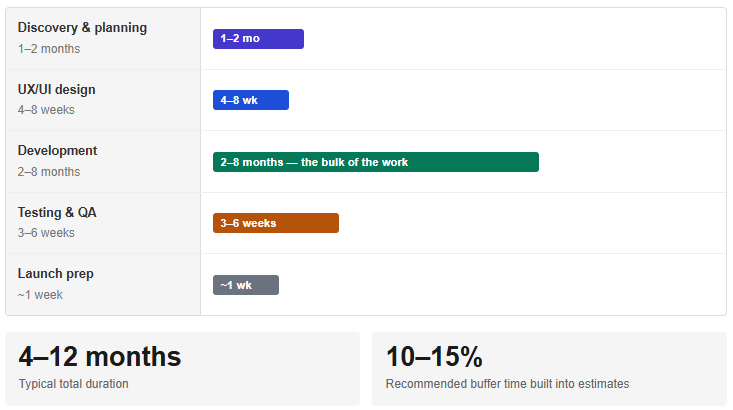
Realistic Project Timeline Benchmarks
Question 4: How Do You Handle Custom Development and Third-Party Integrations?
Almost every serious eCommerce business requires customization beyond what Magento provides out of the box. The difference between a well-architected customization and a poorly implemented one can be the difference between a store that scales smoothly and one that becomes increasingly expensive to maintain.
Custom Development — The Right Approach
Quality custom development should be built as properly scoped modules that follow Magento’s architectural patterns:
- Event-observer pattern for extending existing Magento functionality
- Dependency injection framework for clean, testable code
- Service contracts for stable API interfaces between components
Custom development should never involve modifying Magento’s core files. Core modifications break with every platform update — creating a situation where every Magento upgrade becomes a costly, manual remediation exercise.
Questions to ask about their development standards:
- How is your code version-controlled? (Git is standard; ask about branching strategy and code review process)
- How are custom modules maintained and tested across Magento version upgrades?
- Do you follow Magento coding standards as defined by Adobe?
- Do you conduct peer code reviews before merging changes?
Third-Party Integrations — Common Types and What to Ask
| Integration Type | Examples |
| ERP systems | SAP, Sage, Khaos Control, NetSuite, Microsoft Dynamics |
| CRM platforms | Salesforce, HubSpot, Zoho |
| Payment gateways | PayPal, Stripe, Authorize.Net, Klarna, Affirm |
| Shipping and logistics | FedEx, UPS, Royal Mail, ShipStation, EasyPost |
| Warehouse management | SkuVault, Fishbowl, Linnworks |
| Marketing automation | Klaviyo, Dotdigital, Mailchimp |
| B2B procurement | Punchout catalog integrations, EDI |
| Marketplace management | Amazon, eBay, Google Shopping |
| Analytics | Google Analytics 4, Adobe Analytics, Mixpanel |
For each relevant integration, ask specifically:
- Have you integrated with this specific system before?
- What data flows in each direction, and at what frequency?
- How do you handle integration failures — what happens when an API call fails or a system goes down?
- How are integrations monitored in production?
- Who is responsible for maintaining the integration when a third-party API changes?
Red flag: An agency that responds with generic assurances (“we can integrate with anything”) without providing specific examples or describing their technical approach has likely never done the integration in question. Depth and specificity of answer is the signal to look for.
Question 5: What Is Your Pricing Structure, and How Do You Handle Budget and Scope Changes?
Common Pricing Models
| Model | How It Works | Best Suited For |
| Hourly rate | Billed for actual hours; final cost varies | Ongoing work, undefined or evolving scope |
| Fixed / project-based | Agreed total price for a defined scope | Well-scoped, stable builds |
| Milestone-based | Payments tied to specific deliverables | Most structured projects — recommended |
| Retainer | Fixed monthly fee for ongoing services | Maintenance, support, continuous development |
| Performance-based | Fee tied to specific outcomes (conversions, revenue) | Results-driven, post-launch optimization |
| Hybrid | Combination of models for different phases | Complex, multi-phase projects |
For most eCommerce builds, a milestone-based or hybrid model provides the best balance of predictability and flexibility — aligning payment with progress and giving you clear checkpoints to evaluate quality before proceeding.
What a Complete Quote Should Include
If a proposal doesn’t break out all of the following, ask for it before signing anything:
- Magento license type and cost (Open Source vs. Adobe Commerce, with reasoning for the recommendation)
- Hosting and infrastructure costs
- Domain registration and SSL certificate costs
- Required third-party modules and extensions (with license costs itemized)
- Development hours broken down by phase: discovery, design, development, QA, launch
- UX/UI design — whether bundled or billed separately, and what’s included
- Post-launch support terms and cost structure
- Contingency provisions for unexpected work
The Budget Overrun Question
Ask this directly: “How often do your projects come in over budget, and by how much on average?”
The industry standard for budget variance is 20–30%. An agency with a consistent history of delivering within 15% variance is demonstrably better at scoping. Also clarify:
- Who is responsible for extra time if a task takes longer than estimated due to the agency’s own scoping error?
- What is the formal process for scope changes — is there a written change request process with cost approval required before work begins?
- Are emergency or after-hours deployments billed at a different rate?
- How are unexpected third-party costs handled if new extension requirements emerge mid-project?
Red flag: Any quote dramatically lower than all other proposals is not a bargain. It signals that either the full scope hasn’t been understood, corners will be cut, or hidden costs will surface later.
Question 6: What Are Your Testing, QA, and Security Protocols?
Quality Assurance — What to Ask For
Ask for their QA process in writing or as a process document. A comprehensive QA process covers:
- Functionality testing: Does every feature perform as specified? Are all edge cases covered?
- Performance testing: Core Web Vitals benchmarks (LCP, FID, CLS), page load times across key pages
- Cross-device and cross-browser testing: Chrome, Safari, Firefox, Edge — and full mobile testing
- Integration testing: Are all connected systems passing data correctly? What happens when an integration fails?
- Checkout and payment flow testing: All payment methods, tax calculations, shipping estimates, discounts
- Regression testing: When new code is deployed, does it break existing functionality?
- Security testing: Known vulnerability scanning, penetration testing
Also ask:
- How many test cycles do you run before presenting a build for client review?
- Do you provide documented test reports and bug tracking?
- Can you roll back a deployment if something goes wrong immediately after launch?
Security Protocols — Non-Negotiable Standards
Technical security measures to confirm:
- SSL encryption — implemented and maintained across all environments
- Two-factor authentication (2FA) — required for all Magento admin access
- Role-based access control (RBAC) — restricting who has access to what within the platform
- Security patch management — how quickly are Magento security patches applied after Adobe releases them?
- PCI-DSS compliance — essential for any store processing payments
- GDPR compliance — required for any store serving EU customers
Data Protection and Legal Safeguards
Before sharing any proprietary information, establish:
- Non-Disclosure Agreement (NDA): Should cover handling of proprietary business data, restrictions on sharing with third parties, and clear consequences for breaches
- Code ownership: Custom code built for your store must belong to you, unambiguously, upon project completion. Some agencies include licensing clauses giving them ongoing claims to your codebase — watch for this carefully.
- Code transfer process: At project close you should receive: complete code documentation, repository access (GitHub or Bitbucket) with full commit history, licensing clarity for all third-party modules, and access credentials for all hosting and infrastructure accounts
- Data backup policy: How often are backups made? Where are they stored? How quickly can they be restored? Has the restoration process been tested?
Red flag: Any agency reluctant to sign an NDA before reviewing your project details, or vague about code ownership terms in their contract, is a serious concern.
Question 7: What Does Post-Launch Support Look Like — and Who Will Work on My Project?
Post-Launch Services — What a Comprehensive Offering Looks Like
| Service | What It Covers |
| Security patch management | Applying Magento security patches promptly after Adobe releases them |
| Platform version upgrades | Planning, testing, and deploying major and minor Magento updates |
| Performance monitoring | Proactive identification and resolution of slowdowns before they affect customers |
| Uptime monitoring | 24/7 alerting for downtime events, with defined response SLAs |
| Bug fixes | Prompt resolution of functionality issues that surface after launch |
| Integration maintenance | Updating integrations when third-party APIs change |
| Feature development | Adding new functionality as your business evolves |
| Backup management | Regular, tested backups with verified restoration capability |
| Production environment monitoring | Tracking changes and flagging unusual activity |
Key questions to ask:
- What are your response time commitments for critical (site-down) issues? For non-critical issues?
- Is your support model proactive (monitoring and alerting) or reactive (waiting for you to report)?
- Is post-launch support bundled into the contract, or billed separately? At what rate?
- Do you offer a formal Service Level Agreement (SLA) with defined uptime guarantees?
- Will the same team that built the store handle ongoing support, or does it transition to a separate support team?
Who Will Actually Work on My Project?
This is the question that most frequently goes unasked — and one of the most important. Some agencies present their most senior developers during the sales process, then staff projects primarily with junior developers or offshore contractors after signing.
Ask explicitly:
- Who specifically will be on my project team? (Get names and roles, not just job titles)
- What is each person’s individual Magento experience in years and relevant project types?
- Can I speak with the developers who will be working on my project before we sign?
- Will my project be handled entirely by in-house developers, or will any work be outsourced to subcontractors?
- If subcontractors: how many hold Magento certifications? Can I review their CVs?
- Will there be a dedicated project manager as my single point of contact throughout?
- How do you handle staff turnover mid-project? What is your knowledge transfer process?
- How many other projects will the team assigned to me be running simultaneously?
Red flag: Vague responses — “our best people,” “a highly experienced team,” “we’ll assign resources based on availability” — signal that you may not get what you were shown in the pitch. A transparent, confident agency will answer all of these questions clearly.
Red Flags Checklist
During the sales process
- Slow response times to initial inquiries (if they’re slow now, expect worse later)
- Sends a quote within 24 hours without asking detailed questions about your project
- High-pressure tactics or artificial urgency (“this offer expires Friday”)
- Reluctance to provide references or connect you with past clients
- Cannot name specific systems they’ve integrated with
- Unverifiable or vague partner/certification credentials
In the proposal
- Price dramatically lower than all other proposals — without a clear explanation
- Promises of delivery in weeks for a complex build
- Missing cost components (no mention of hosting, licensing, extensions, post-launch support)
- No mention of QA process, testing cycles, or security protocols
- Vague language around scope boundaries and what’s included
In the contract
- Ambiguous or absent code ownership clauses
- Resistance to signing an NDA before project discussions
- Large upfront payment requirements with no milestone-based structure
- Vague acceptance criteria — “project completion” not defined
- No defined dispute resolution process
Agency Evaluation Framework
Use this framework to compare agencies after your conversations:
| Criteria | Strong Agency | Weak Agency |
| Certifications | Adobe Solution Partner + Hyvä certified, verifiable | Vague claims, unverifiable credentials |
| Experience | 10+ years, detailed case studies, relevant industry examples | <5 years, generic portfolio, no relevant examples |
| Discovery process | Asks detailed questions before proposing anything | Sends a quote within 24 hours of first call |
| Custom development | Explains module architecture, version control, upgrade strategy | “We can build anything” with no technical detail |
| Integrations | Named systems, specific data flows, error handling explained | Generic assurances without specifics |
| Pricing | Full cost breakdown, clear overrun policy, milestone payments | Single line-item total, large upfront payment demands |
| QA and testing | Documented process, multiple cycles, regression testing | “We test everything” with no documented process |
| Security | NDA standard, RBAC, 2FA, patch management defined | Vague or defensive about security practices |
| Post-launch support | Proactive monitoring, named SLAs, same team continuity | “We’ll be available” with no defined terms |
| Team transparency | Named team, verifiable credentials, direct access pre-signing | Vague about who will actually work on the project |
Evaluating References and Portfolio
Never skip reference checks. Contact past clients and ask specific, direct questions:
- How closely did the delivered product match the original specifications and timeline?
- How close was the final cost to the initial estimate — and how were overruns handled?
- How responsive and transparent was the agency throughout development?
- How did they handle problems or unexpected technical challenges?
- What would you do differently if you were starting the engagement over?
- Would you hire them again for your next project?
When reviewing their portfolio, go beyond screenshots. Visit the live websites. Test them on mobile. Walk through the checkout process. Check page load speed using Google PageSpeed Insights. A portfolio of visually attractive stores that score 25/100 on mobile performance tells you something important about the agency’s technical priorities.
The Right Partner Makes All the Difference
A Magento agency relationship typically lasts for years, not months. The initial build or migration is only the beginning. The ongoing development, integration maintenance, platform upgrades, security management, and continuous optimization that follow are where the quality of the partnership is most felt — and where the wrong choice costs the most.
The questions in this guide aren’t just a vetting checklist. They’re a framework for understanding whether an agency has the expertise, the transparency, the technical standards, and the operational maturity to support your business for the long term.
Ask them early. Ask them directly. Pay close attention to the quality of the answers, not just the content. A vague answer to a specific question is itself an answer.
Ready to talk to a Magento agency that asks the right questions?
Accelerate your eCommerce growth with Bemeir. As an Adobe Solution Partner and Hyvä Gold Partner, we help brands build faster, higher-converting Magento and Adobe Commerce experiences that scale. From custom development and high-performance Hyvä storefronts to ERP integrations, optimization, and long-term support, our certified experts deliver the strategy, technology, and execution needed to outperform competitors and drive measurable results.
Schedule a 30-minute discovery call with Bemeir to build smarter, move faster, and turn your Magento investment into a competitive advantage.
Frequently Asked Questions
1. How much does it cost to hire a Magento agency?
Magento agency pricing varies significantly depending on project complexity, customization requirements, integrations, and whether you’re using Magento Open Source or Adobe Commerce. A basic Magento build may start around $25,000, while highly customized enterprise implementations can exceed $125,000. Ongoing costs such as hosting, extensions, maintenance, and support should also be included when evaluating total cost of ownership.
2. What is the difference between Adobe Solution Partner tiers?
Adobe Solution Partner tiers indicate an agency’s level of experience, technical expertise, and long-term investment in the Adobe Commerce ecosystem. Tiers range from Bronze and Silver up to Gold, Platinum, and Global Elite. Higher-tier partners typically demonstrate stronger delivery capabilities, more certified developers, and a larger portfolio of successful Magento and Adobe Commerce implementations.
3. How long does a Magento or Adobe Commerce project usually take?
Magento project timelines depend on the size and complexity of the build. Smaller projects may take 8–12 weeks, while larger enterprise implementations with custom integrations, B2B functionality, or migration requirements can take 6–12 months or longer. A realistic timeline should include discovery, UX/UI design, development, QA testing, integrations, performance optimization, and post-launch stabilization.
4. What is a Hyvä Gold Partner?
A Hyvä Gold Partner is an agency recognized for advanced expertise in the Hyvä frontend framework for Magento 2. This designation is awarded to agencies that have completed Hyvä certification requirements and successfully delivered multiple Hyvä storefront projects. Hyvä Gold Partners are typically experienced in improving Magento performance, Core Web Vitals, mobile speed, and frontend maintainability.
5. Should I work with an offshore Magento agency?
Offshore Magento agencies can offer cost advantages, especially for development-heavy projects. However, businesses should carefully evaluate communication processes, time zone overlap, technical standards, and project management structure before committing. The right offshore agency can deliver excellent results, but success often depends on having clearly defined requirements, strong documentation, and transparent workflows in place.
6. How do I know if a Magento agency is experienced with integrations?
An experienced Magento agency should be able to discuss specific integrations in detail, including ERP systems, CRMs, payment gateways, shipping providers, and marketplace platforms. Ask which systems they have integrated previously, how they handle API failures, how data synchronization works, and what monitoring processes they use in production. Strong agencies provide technical specificity rather than generic assurances.
7. What should post-launch Magento support include?
Post-launch Magento support should go beyond fixing occasional bugs. A comprehensive support plan typically includes security patch management, Magento version upgrades, uptime monitoring, performance optimization, integration maintenance, backups, and emergency issue response. Businesses should also ask whether the same team that built the store will continue supporting it after launch and whether formal SLAs are included.