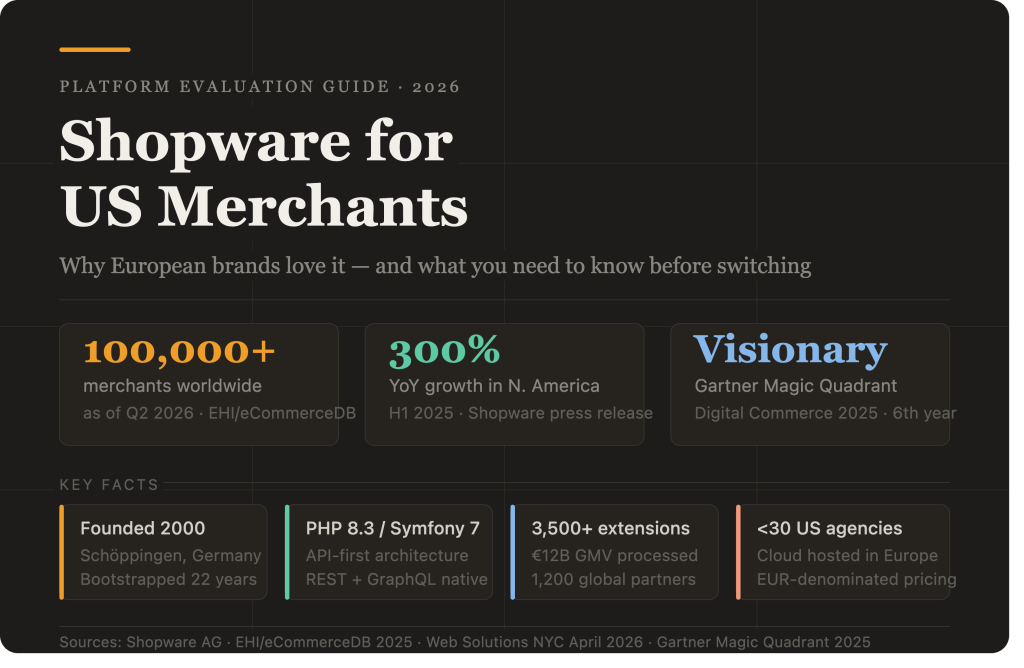
Shopware is Europe’s dominant open-source eCommerce platform, powering over 100,000 merchants worldwide and holding the top position among Germany’s top 1,000 online shops for four consecutive years, according to the 2025 EHI study. Until recently, the platform was almost invisible in the US market. That changed in 2025: Shopware reported 300% year-over-year growth in North America for the first half of the year, per a Shopware press release dated July 22, 2025. Gartner named it a Visionary in the 2025 Magic Quadrant for Digital Commerce. US merchants considering a platform evaluation now need a straight-talking answer to a specific question: is Shopware actually right for a US operation, or is this a European platform that travels poorly?
| TL;DR — Key Takeaways |
| Shopware is a German-founded, open-source eCommerce platform with over 100,000 merchants worldwide as of Q2 2026, including 115 of Germany’s top 1,000 B2C online shops (EHI/eCommerceDB study, 2025). Gartner named it a Visionary in the 2025 Magic Quadrant for Digital Commerce. |
| Its strongest differentiators for European brands are Shopping Experiences (an integrated content-commerce page builder), a modern PHP 8/Symfony 7 API-first architecture, a built-in Rules Engine with 50+ conditions for business logic automation, and a B2B feature set that covers quick order, quote management, and customer-specific pricing without custom development. |
| US merchants face real, documented limitations: fewer than 30 certified Shopware agencies in North America as of early 2026 (Web Solutions NYC, April 2026), fewer US-native payment and shipping integrations than Magento, and Shopware Cloud hosted in Europe by default — requiring deliberate US-based infrastructure choices for acceptable latency. |
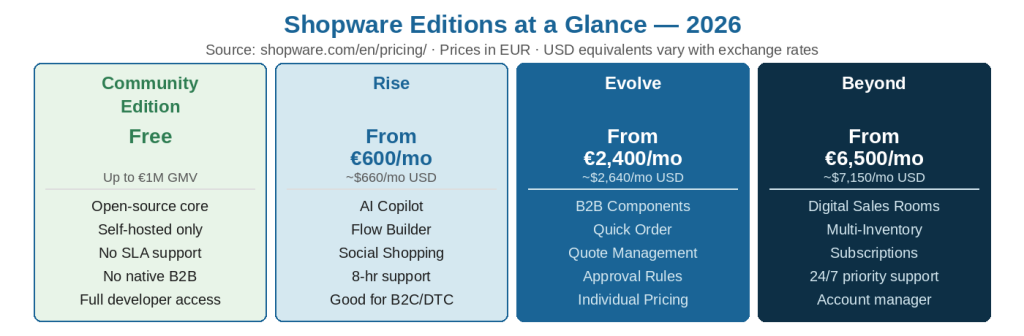
| Shopware’s commercial plans start at €600/month (Rise) and €2,400/month (Evolve) per shopware.com/en/pricing/. The Community Edition is free but capped at €1 million GMV as of March 2025. All pricing is EUR-denominated, so USD costs fluctuate with exchange rates. |
| For US merchants running Magento Open Source or Adobe Commerce, re-platforming to Shopware is a full rebuild — no shared codebase, no shared extensions, no shared theme framework. The case for switching must be driven by specific platform gaps, not platform novelty. |
1. What Shopware Is and Where It Comes From
Shopware was founded in 2000 by Stefan Hamann — then 16 years old — during the Dot-com crash, in Schöppingen, a small town in North Rhine-Westphalia. His brother Sebastian joined shortly after. The company ran bootstrapped and profitable for 22 years before raising $100 million from Carlyle and PayPal in 2022, per public reporting. PayPal now holds approximately 41% of Shopware AG after acquiring Carlyle’s stake in October 2025, according to the Qualimero independent guide (2026).
That 22-year bootstrapped history shaped the product in a way that matters for evaluation: features evolved from direct merchant feedback, not investor growth targets. The DACH mid-market — Germany, Austria, Switzerland — was Shopware’s primary user base for most of its existence, and the platform reflects their specific requirements. GDPR compliance, EU VAT handling, SEPA payment methods, Klarna integration, invoice-based B2B payment, and German-language storefronts are native to the platform, not retrofitted.
The current commercial version is Shopware 6 — a complete ground-up rewrite on a modern PHP/Symfony 7 stack with Vue.js powering the administration interface. This is an important distinction: Shopware 5 is legacy and end-of-life. Any evaluation of Shopware for a new US build starts with Shopware 6 specifically. Shopware’s position in the European market is roughly equivalent to where Magento stood in the US around 2015 — the default platform for mid-market and enterprise merchants who need flexibility and B2B depth.
Shopware employs approximately 400 people, maintains over 1,200 technology and sales partners globally, and has a plugin store with over 3,500 extensions. Shopware has been recognized as a Visionary in the Gartner Magic Quadrant for Digital Commerce for six consecutive years as of November 2025, per a Shopware press release dated November 7, 2025. The combined annual revenue processed across Shopware stores is €12 billion, per Qualimero’s 2026 independent guide.
2. Why European Brands Choose It: The Real Reasons
Understanding why European merchants choose Shopware is the most useful starting point for a US evaluation. The reasons are specific, and not all of them translate cleanly to a US context.
Built-in regulatory compliance for the EU
GDPR compliance is native to Shopware’s architecture. GDPR-compliant cookie consent, data processing agreements, right-to-erasure workflows, and data portability tools are built into the platform — not added via extensions. For European merchants, this reduces legal risk and development overhead substantially. For US merchants whose primary compliance concern is PCI-DSS and ADA/WCAG, these European compliance capabilities are real but largely irrelevant to day-to-day operations.
The European Accessibility Act (EAA), which came into effect for commercial operators in June 2025, requires digital products to meet WCAG 2.1 AA accessibility standards across EU member states. Shopware’s development roadmap has explicitly addressed EAA compliance, per the 2hatslogic.com analysis of European Shopware adoption (April 2026). US merchants operating in CCPA-regulated environments or seeking WCAG 2.1 AA compliance benefit from this foundation, even without operating in the EU directly.
Shopping Experiences: the content-commerce differentiator
Shopping Experiences is Shopware’s integrated drag-and-drop page builder. Marketing and merchandising teams use it to build category pages, campaign landing pages, and editorial product pages that mix product listings, editorial content, video, and promotional blocks without writing code or raising developer tickets. For European fashion, lifestyle, home goods, and design brands that compete on visual storytelling, this is the single most cited reason Shopware wins deals over Magento.
The practical advantage: a merchandising team can build a new seasonal campaign page from scratch, combine product recommendations with editorial copy and a video banner, and publish it without involving a developer. This capability exists in Adobe Commerce as content staging and Page Builder, and in Magento Open Source as a basic Page Builder. Shopware’s version is considered more accessible to non-technical merchandisers by independent evaluators, though it lacks Adobe Commerce’s content scheduling and auto-rollback — the ability to set a campaign live at midnight and have it revert automatically 72 hours later.
Modern API-first architecture and developer experience
Shopware 6 was rebuilt on PHP 8/Symfony 7 with a fully API-first design: every function in the admin is accessible through a documented REST or GraphQL API. This makes headless and composable builds straightforward by architectural choice, not by extension. For development teams evaluating platform modernity, Shopware’s stack is genuinely more contemporary than Magento’s Zend/Laminas heritage. The Rules Engine — a built-in framework for defining conditions that automate business logic, from pricing rules to workflow triggers — reduces the volume of custom development required for complex operational requirements.
For US merchants building headless storefronts or integrating external systems (ERP, PIM, AI agents), Shopware’s architecture is a real advantage. Shopware also offers three deployment models — SaaS cloud-hosted, PaaS managed, and fully self-hosted — giving technical teams more infrastructure flexibility than Shopify Plus.
B2B capabilities that do not require an enterprise contract
Shopware’s B2B Components suite — available on the Evolve plan (€2,400/month) — includes Quick Order by SKU or CSV, Quote Management (buyers request quotes from the storefront; sales reps respond from the admin), Employee Management with role-based access, Approval Rules, Shopping Lists, and Organization Units for parent-child company hierarchies. The March 2026 Shopware 6.7.8 release added Individual Pricing to B2B Components, enabling customer-specific price books with percentage-based, total, or tiered discounts, per the Qualimero Shopware editions comparison (2026).
The key distinction for US merchants: Adobe Commerce’s B2B module requires the Adobe Commerce license (starting at approximately $22,000/year per mgt-commerce.com 2026). Shopware’s equivalent B2B functionality requires the Evolve plan (€2,400/month, per shopware.com/en/pricing/ — EUR-denominated, so verify the current USD equivalent). At comparable price points, neither platform has a universal advantage — the right choice depends on the depth of B2B requirements and the importance of US agency ecosystem support.
AI Copilot and the 2026 AI roadmap
Shopware renamed AI Copilot to Shopware AI in June 2025; it is a chat-based assistant embedded in the admin panel. It generates product descriptions, translates content, creates image backgrounds for Shopping Experiences pages, summarizes product reviews, and suggests product properties, per the Qualimero 2026 independent guide. Shopware hosts the infrastructure in Europe with GDPR compliance built in and does not use merchant data for model training.
Shopware’s 2026 roadmap adds agentic capabilities through Shopware Intelligence+, where the AI moves from answering questions to taking actions across store data. Shopware also launched the Agentic Commerce Alliance in April 2025, an initiative aimed at protecting merchant independence as AI monopolization by large platforms increases, reported by Digital Commerce 360 (July 2025). For US merchants who see AI-driven commerce as a strategic priority, Shopware’s roadmap is genuinely forward-looking — though the practical AI features available today are primarily admin-side efficiency tools, not revenue-driving storefront personalization.
3. The Platform Tiers: What You Get at Each Level
Shopware’s pricing structure changed in March 2025 with the introduction of the Fair Usage Policy, which capped the free Community Edition at €1 million GMV. Understanding the current tier structure accurately is essential before any evaluation.
| Edition | Price (2026) | Key US-relevant considerations |
| Community Edition | Free | Capped at €1M GMV since March 2025. Self-hosted only. No SLA. No native B2B. Full developer access. Practical for technical teams evaluating the platform, not for mid-market US production deployments. |
| Rise | From €600/mo | AI Copilot, Flow Builder, Social Shopping, 8-hour support response. Suitable for B2C and DTC brands. Not sufficient for B2B functionality or catalogs above a few thousand SKUs. |
| Evolve | From €2,400/mo | Minimum required tier for meaningful B2B. Includes B2B Components (Quick Order, Quote Management, Approval Rules, Individual Pricing), Advanced Search, 4-hour support SLA. Positioned as Shopware’s “bestseller” for mid-market merchants. |
| Beyond | From €6,500/mo (custom pricing) | Enterprise tier: Digital Sales Rooms, Multi-Inventory, Subscriptions, 24/7 premium support, personal account manager. Suitable for large operations where commerce is the primary revenue channel. |
Source: shopware.com/en/pricing/ and Qualimero Shopware editions comparison (2026). All prices in EUR; USD equivalents fluctuate with exchange rates and are directional only.
| The GMV cap matters more than it looks |
| The Community Edition’s €1 million GMV cap, introduced March 2025, effectively removes the free option for most mid-market US merchants. Rise (€600/month) is the practical entry point for any commercial US deployment. |
4. Where Shopware Falls Short for US Merchants
Independent evaluators writing from a US perspective are consistent on this point. The limitations are real, they are documented, and they are not addressed by Shopware’s marketing.
The US agency ecosystem is thin — fewer than 30 certified partners
As of early 2026, fewer than 30 certified Shopware agencies operate in North America, compared to thousands for Shopify and hundreds for Magento, per Web Solutions NYC’s April 2026 US market guide. That gap means fewer implementation partner options and potentially longer wait times for project starts. Finding a US-based agency with genuine Shopware 6 production experience requires more due diligence than finding a qualified Magento or Shopify agency — verifying actual production projects, not just a certification badge, is the right diligence step.
Shopware is aware of this and is actively investing. The company hired Ryan Mercier as VP of Sales for North America in July 2025 and hosted its second North America Partner Day in Austin in April 2026. The ecosystem is growing — but growth from thin is not the same as depth that already exists.
US infrastructure requires deliberate configuration
Shopware Cloud is hosted in Europe by default. For US merchants, this creates latency issues that affect storefront performance and Core Web Vitals scores. Self-hosted or PaaS deployments need US-based infrastructure for acceptable latency — this is not a theoretical concern. For a US storefront, server response times from European infrastructure add 80–200ms of round-trip latency, which directly affects Time to First Byte (TTFB) and Largest Contentful Paint (LCP) scores.
The practical fix is straightforward: deploy on US-based infrastructure using Shopware PaaS on AWS or Azure US regions, or self-host on a US-based provider. But it requires knowing this upfront, not discovering it post-launch.
Payment and shipping integrations for the US are fewer
Shopware’s plugin store stocks a wide range of European payment providers (Mollie, Klarna, SEPA) and European logistics options. For US operations, PayPal, Stripe, PayTrace, and BlueSnap now have official integrations following Shopware’s 2025 US partner expansion (Shopware press release, July 22, 2025). But the breadth of US-native integrations for carriers like UPS, FedEx, and USPS, or for US tax compliance platforms like Avalara and TaxJar, is not yet at the level of Magento’s Marketplace.
For most US implementations, this gap is manageable: the core platform combined with Stripe, a US shipping provider, and Avalara for tax covers the standard requirements of most US commerce operations. The gap becomes a real problem only when specific US integrations — a specialized B2B payment gateway, a particular 3PL integration, or a US-specific ERP connector — do not have Shopware plugins and require custom development.
Content staging and campaign scheduling is not native
Adobe Commerce’s content staging — prepare a promotional campaign, schedule it to go live at a specific time, have it roll back automatically — has no direct equivalent in Shopware’s current feature set. For US retail merchants who run frequent time-sensitive campaigns, this is a workflow gap that Shopping Experiences, while capable, does not fully close. Shopware’s Flow Builder automates event-triggered actions, but pre-scheduled content publishing with auto-rollback is not the same capability.
Migration from Magento is a full re-platform
Shopware and Magento share no codebase, no database schema, and no extension framework. Migrating from Magento Open Source or Adobe Commerce to Shopware is a complete rebuild: new theme, new extensions, new integrations, rewritten custom code, and a data migration that requires careful validation of products, customers, orders, and SEO URL structures. Any agency describing this as a lift-and-shift migration is not giving you an accurate picture.
5. Platform Comparison: Shopware vs. Magento vs. Shopify Plus
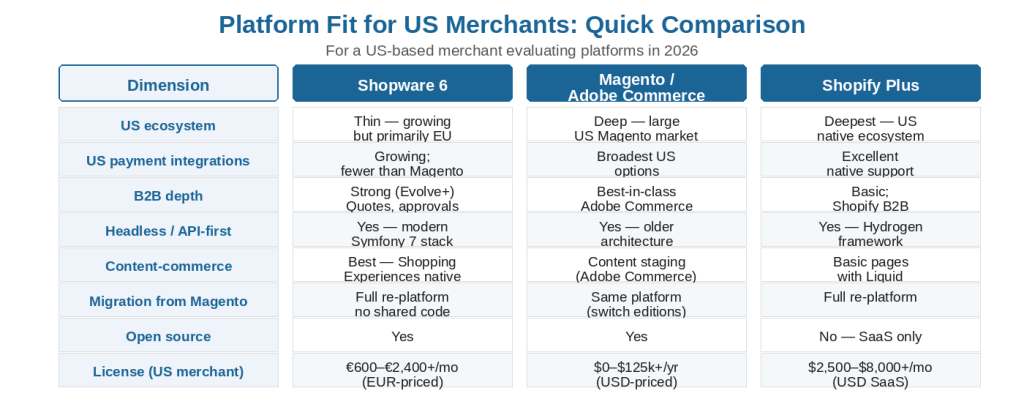
The table below covers the dimensions most relevant to a US merchant making a platform evaluation in 2026. The visual summary above gives a quick-reference overview.
| Dimension | Shopware 6 (Evolve) | Magento Open Source / Adobe Commerce | Shopify Plus |
| License cost | €2,400/mo for B2B (EUR-denominated; verify USD at time of purchase) | Free (Open Source) or $22k–$125k+/yr (Adobe Commerce) — mgt-commerce.com 2026 | $2,500–$8,000+/mo USD |
| Tech stack | PHP 8 / Symfony 7 / Vue.js — modern, API-first by design | PHP 8.3/8.4 / Laminas / Knockout.js — older architecture, API-accessible | Proprietary SaaS — Liquid templates, Hydrogen for headless |
| Content-commerce (page building) | Shopping Experiences — best-in-class drag-and-drop, no scheduling | Adobe Commerce: content staging + scheduling. Open Source: basic Page Builder only | Basic pages with Liquid; limited editorial capability |
| B2B depth | Strong on Evolve: Quick Order, quotes, approval rules, individual pricing | Adobe Commerce: native module (best-in-class). Open Source: requires extensions | Shopify B2B launched 2022 — growing but shallower than either open-source option |
| US agency ecosystem | Fewer than 30 certified US agencies (Web Solutions NYC, 2026) | Hundreds of US Magento agencies — deepest open-source commerce talent pool | Thousands of US Shopify agencies — largest ecosystem overall |
| US payment integrations | PayPal, Stripe, PayTrace, BlueSnap — growing but fewer options | Broadest US integration options via Magento Marketplace | Excellent native US payment support; Shopify Payments, Stripe, all major gateways |
| Frontend customization depth | Vue.js Storefront — modern, theme-able, fully custom via API | Theme-able via Luma or third-party frontends; full source access | Liquid templates — customizable within Shopify’s theme system |
| Open source | Yes — full source access on all plans | Yes — full source access on all plans | No — closed SaaS; limited customization depth |
| Default hosting location | Europe (cloud); requires deliberate US configuration for US merchants | Self-hosted — you choose location; no default latency issue | Global CDN with US points of presence — no latency issue |
| Migration from Magento | Full re-platform — no shared codebase, significant effort and cost | Same platform — can upgrade from Open Source to Adobe Commerce without full rebuild | Full re-platform — significant effort |
6. The Merchants Shopware Is Winning in the US
Shopware’s 2025 US client wins give a useful picture of the profile the platform is attracting. The clients named in Shopware’s July 2025 North America press release — UPPAbaby (premium baby gear), Good360 (B2B nonprofit goods redistribution), Eagle Crusher (heavy industrial equipment), BlueAlly (IT services), and Dynamic Team Sports — share a pattern: mid-market brands with either European ties, complex B2B workflows, or product lines that benefit from visual storytelling.
The business profiles where Shopware’s US case is strongest fall into three categories: mid-market B2B manufacturers and distributors who need account-specific pricing and quote workflows; DTC brands with content-heavy merchandising requirements where Shopping Experiences replaces a separate CMS; and merchants already evaluating a migration away from Magento who find Adobe Commerce’s pricing trajectory difficult to justify.
The profile that does not fit is equally clear: US-native DTC brands with simple catalog requirements and no European operations, who do not need Shopware’s compliance infrastructure and would find the thinner US ecosystem a genuine operational friction.
7. The Agentic Commerce Angle: Shopware’s 2026 Positioning
Shopware builds its 2026 strategic positioning around what it calls “agentic commerce” — a vision of AI-driven, autonomous buying and selling that reduces the role of traditional discovery and checkout flows. In April 2025, Shopware launched the Agentic Commerce Alliance, described by Digital Commerce 360 as an initiative to “ensure merchant autonomy” as AI agents from Google, Amazon, and OpenAI increasingly mediate consumer purchase decisions.
In practical terms, Shopware’s 2026 AI roadmap includes Shopware Intelligence+ (agentic admin capabilities), AI-generated product content, and the beginnings of API-accessible commerce infrastructure designed to serve AI shopping agents. Shopware also announced a Merchant of Record partnership model for international selling, simplifying cross-border tax and compliance for merchants expanding globally — directly relevant to European brands entering the US market, per shopware.com/en/news/global-expansion-merchant-of-record/.
Whether these positioning moves translate to measurable competitive advantage for US merchants in the near term is unclear. The agentic commerce narrative is compelling, but most US merchants are not yet running operations where AI agent commerce is a significant revenue channel. For a US merchant evaluating platforms today, the AI roadmap is a directional signal, not a decision factor.
8. Bemeir: A Shopware Partner Built for US Merchants
Most Shopware agencies serving the US market are European firms with a US contact, not a US-built operation. Bemeir is different: a US-based agency with 12+ years of eCommerce platform experience, applying that depth to Shopware implementations specifically for US merchants — not retrofitting a DACH playbook onto an American storefront.
- Platform decisions based on your business. Bemeir works with merchants on both Shopware and Magento. The recommendation in a discovery call is driven by your B2B requirements, your content-commerce needs, and your budget — not by which platform happens to be the only one an agency knows how to build.
- US-region infrastructure from the first commit. Shopware Cloud defaults to European hosting, which is the single most common latency mistake US merchants make. Bemeir architects every Shopware build on US-region infrastructure — PaaS on AWS or Azure US regions, or self-hosted on a US-based provider — so Core Web Vitals and Time to First Byte are solved at the architecture stage, not patched after launch.
- The US integration gap, closed before it becomes a problem. Bemeir scopes US payment, shipping, and tax integrations — Stripe, US carriers, Avalara — as a standard part of Shopware discovery, and identifies early which specific integrations need custom development instead of discovering it mid-build.
- Migration scoping with no surprises. Moving from Magento to Shopware is a full re-platform with no shared codebase. Bemeir scopes the complete picture upfront — theme, extensions, integrations, and data migration — so the project timeline and budget you are given at the start is the one you finish with.
- One discovery call, a direct recommendation. Bemeir does not need six meetings to tell you whether Shopware fits. A single 30-minute discovery call covers your B2B requirements, your content and merchandising needs, and your budget — and ends with a specific platform recommendation, not a generic sales deck.
9. Shopware Technical Specifications for US Evaluators
For technical teams scoping a Shopware 6.7.8 project (current release as of March 2026 per mgt-commerce.com), the server requirements are:
| Technology | Shopware 6.7.8 requirement | Notes for US infrastructure |
| PHP | PHP 8.2+ (8.3 recommended) | PHP 8.3 is also Magento 2.4.8’s recommended version — consistent for US development teams |
| Framework | Symfony 7 | More modern than Magento’s Laminas. Symfony developers are more common in the US than Shopware specialists specifically |
| Frontend / Admin | Vue.js (admin and Storefront) | Different from Magento’s KnockoutJS/Luma or Hyvä’s AlpineJS/Tailwind CSS stack |
| Search | OpenSearch or Elasticsearch (Advanced Search on Evolve) | OpenSearch is also the standard for Magento 2.4.7+ — US infrastructure teams will find this familiar |
| Database | MySQL 8.0+ or MariaDB | Same as Magento 2.4.8 database requirement |
| Deployment models | SaaS cloud-hosted, PaaS managed, self-hosted | Cloud defaults to European hosting. PaaS on AWS/Azure US regions is required for low-latency US deployments. Self-hosted gives full infrastructure control. |
| API architecture | REST and GraphQL — fully API-first | More complete out-of-the-box API coverage than Magento, which added GraphQL progressively. Advantage for headless and composable builds. |
10. Frequently Asked Questions
Is Shopware suitable for US merchants?
It depends on the specific situation. Shopware is well-suited for European brands entering the US market, DTC merchants where content-commerce is central to conversion, and teams building headless architectures on a modern PHP/Symfony stack. For US-native merchants who need deep US payment and shipping integrations, a mature local agency ecosystem, and complex B2B functionality with production-hardened support, Magento Open Source or Adobe Commerce remains the more practical choice for a US-first operation in 2026.
How does Shopware pricing compare to Magento for US merchants?
Shopware Evolve (the minimum for B2B functionality) starts at €2,400/month, per shopware.com/en/pricing/ All Shopware plans are EUR-denominated, so the USD cost fluctuates with exchange rates — verify the current equivalent before budgeting. Adobe Commerce starts at approximately $22,000/year for merchants doing $1M–$5M in GMV, per mgt-commerce.com’s 2026 pricing analysis. The two platforms are broadly comparable in license cost at the entry level for B2B.
Can I run Shopware with US hosting?
Yes, but it requires deliberate configuration. Shopware’s cloud option defaults to European hosting. For US merchants, the options are: Shopware PaaS on AWS US East or AWS US West regions, self-hosted on a US-based provider, or a CDN layer in front of European-hosted infrastructure. US-based infrastructure is the right call for any production US deployment where TTFB and Core Web Vitals scores matter. Most US implementations use either Shopware PaaS on US-region cloud or fully self-hosted setups.
Does Bemeir build and migrate Shopware stores?
Yes. Bemeir works with merchants on both Shopware and Magento, including new Shopware builds and migrations from Magento to Shopware where Shopware is the better fit. Discovery includes a side-by-side feature and cost comparison specific to your business, US-region infrastructure setup from the start, and honest scoping of the migration effort if you are moving off an existing platform. See bemeir.com/shopware/ for Bemeir’s full platform advisory services.
Is migrating from Magento to Shopware worth it?
It depends on what is driving the evaluation. If you are experiencing specific, measurable gaps on Magento — your merchandising team needs better content-commerce tools, your architecture needs a more modern API-first stack, or your European operations need better regulatory compliance — Shopware may address those gaps. If the motivation is general platform fatigue, you must weigh the re-platforming cost and risk (full rebuild, new agency search, new extension ecosystem, new d…If the motivation is general platform fatigue, you must weigh the re-platforming cost and risk (full rebuild, new agency search, new extension ecosystem, new developer training) against the specific value gained. A proper platform discovery conversation is the only honest way to answer this question for your specific operation.
| Evaluating Platforms for Your US Operation? |
| Bemeir builds and migrates both Shopware and Magento stores — 12+ years of platform expertise. |
| Schedule a 30-minute discovery call — or request a free site speed audit. |
| bemeir.com/shopware/ • (212) 401-1969 |