As a Hyvä Gold Partner, Bemeir has seen first-hand how migrating from Magento’s legacy Luma theme to Hyvä transforms not only site speed, but also organic rankings, bounce rates, and ultimately revenue. As active contributors to the Hyvä ecosystem, Bemeir developed Hyvä Widgets — now used by 250+ Magento stores — reflecting deep, hands-on engineering expertise beyond standard implementation work. This article explains the SEO impact behind Hyvä’s performance gains and helps stakeholders understand the real business value of migration.

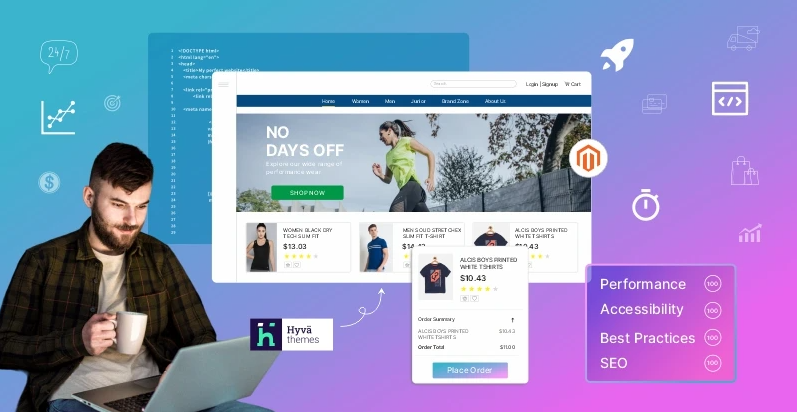
Hyvä itself is a modern Magento 2 frontend built to replace Luma’s heavy JavaScript and CSS architecture with a lightweight, performance-first stack. The result is significantly faster load times, improved Core Web Vitals, better crawl efficiency, and stronger mobile performance — all of which directly influence Google rankings and user behavior.
For ecommerce businesses, this translates into more visibility in search, better user engagement, and higher conversion rates. However, the full SEO benefit depends on proper implementation, extension compatibility, and ongoing performance discipline — Hyvä is a foundation for speed, not an automatic guarantee.
1. What Is the Hyvä Theme and Why Does It Matter?
The Hyvä theme is a modern, ground-up frontend rebuild for Magento 2, launched in 2021. It was designed to do one thing extremely well: make Magento fast. Magento’s default Luma theme loads over 200 JavaScript and CSS resources totalling roughly 1.5 megabytes. Hyvä loads just two files — around 0.2 megabytes.
That difference is not cosmetic. It changes how search engines crawl your site, how users experience it, and how Google ranks it. Hyvä replaces Luma’s heavy stack (KnockoutJS, RequireJS, jQuery) with a minimal pairing of AlpineJS and Tailwind CSS — both lightweight, both built for modern browsers.
Why the Default Magento Theme Holds You Back
The Luma theme suffers from two core performance liabilities. First, its CSS files can reach 3–4 megabytes, including styles for features you don’t use. Second, its JavaScript architecture creates deep chains of dependency — one script requires another library, which requires yet another — loading tens of megabytes even for simple checkout flows. This is especially punishing on mobile, where Google tracks real user experience for ranking purposes.
2. How PageSpeed Directly Affects SEO Rankings
Google has made page experience a formal ranking signal. That means your site’s loading speed, visual stability, and interactivity are directly factored into where you appear in search results. This is measured through Core Web Vitals — Google’s real-user performance dataset collected via the Chrome browser.
| Core Web Vital | What It Measures | Hyvä’s Impact |
| LCP (Largest Contentful Paint) | How fast the hero content loads | Reduced JS dependencies accelerate rendering |
| INP (Interaction to Next Paint) | How fast pages respond to clicks/taps | AlpineJS reduces execution time dramatically |
| CLS (Cumulative Layout Shift) | How stable the page is while loading | Optimized CSS prevents unexpected layout shifts |
Important Distinction
Google’s Lighthouse score and Core Web Vitals are not the same thing. Lighthouse is a lab test — it doesn’t determine your search ranking. Core Web Vitals, based on real Chrome user data, is what Google uses for SEO. A site can have a 73% Lighthouse score and still be the fastest Magento site in real-user rankings. Always optimize for Core Web Vitals, not Lighthouse scores.
Crawl Budget: The SEO Benefit You’re Probably Overlooking
Google allocates each website a crawl budget — a limit on how many pages it will crawl in a given period. Slow, heavy sites waste that budget. Hyvä’s lightweight architecture means Googlebot can crawl your site faster and more deeply, getting more of your pages indexed and ranked without delay.
- Fewer server requests mean Googlebot moves through pages more efficiently
- Clean, structured HTML is parsed and understood faster
- Faster load times allow more frequent crawl cycles
- Important product and category pages get indexed without delay
3. The Technical SEO Advantages of Hyvä
Hyvä’s SEO benefits aren’t abstract. They’re grounded in specific technical decisions that change how search engines and users interact with your store.
Mobile-First Architecture
Google operates on a mobile-first indexing policy, meaning it uses your mobile site’s performance to determine rankings for all users. Hyvä is built mobile-first from the ground up — every design decision accounts for smaller screens, touch interactions, and variable network speeds. The theme automatically adapts to any screen size, ensuring consistent performance across devices.
Lightweight Code Structure
Replacing Luma’s bloated frontend with Hyvä’s lean codebase produces dramatic file size reductions. CSS files drop from 3–4 megabytes to roughly 700 kilobytes. JavaScript is reduced to a single lightweight framework (AlpineJS) rather than multiple competing libraries. This directly accelerates every performance metric Google tracks.
Efficient Caching
Hyvä introduces meaningful improvements to Magento’s caching layer. It eliminates heavy JavaScript dependencies that complicate cache invalidation, optimizes Full Page Cache (FPC) for Varnish, and uses Edge Side Includes (ESI) to cache content more effectively than traditional Magento setups. The result is reduced server load and faster time-to-first-byte (TTFB) — a metric that impacts both rankings and user perception.
Built-in Lazy Loading and Media Optimization
eCommerce stores are image-heavy by nature. Hyvä includes native lazy loading, ensuring images load only when they’re needed rather than all at once. Combined with best practices for media optimization, this keeps initial page weight low and perceived performance high — critical for both SEO and conversion.
Schema Markup Support
Hyvä’s clean HTML structure makes it significantly easier to implement and maintain structured data (schema markup). This means your product pages can display rich snippets in search results — star ratings, pricing, stock availability — improving click-through rates and driving more qualified traffic without additional ad spend.
“After migrating to Hyvä, we moved into the green zone for the desktop version and green-yellow for mobile — a significant improvement from the yellow and red-yellow zones we were previously in.” Mirasvit, after Hyvä migration
4. Real-World Performance and SEO Outcomes
The case for Hyvä isn’t theoretical. Stores that have migrated consistently report measurable improvements across SEO and revenue metrics.
According to the latest HTTP Archive Technology report (November 2025, mobile data), traditional Magento stores continue to struggle with Core Web Vitals (CWV), with only 41% achieving good scores. WordPress performs at 46%, while Shopify leads among major platforms at 77% (a self-hosted platform that is difficult to compete with).
However, Hyvä theme dramatically transforms Magento’s performance story. An impressive 65% of Hyvä-based Magento stores achieve excellent CWV scores. This puts Hyvä theme ahead of both traditional Magento (41%) and WordPress (46%), and significantly closer to Shopify’s performance levels.
Case Study: SD Bullion’s 40% Conversion Lift on Hyvä
One of the clearest demonstrations of Hyvä’s SEO and revenue impact comes from SD Bullion — a $1 billion GMV precious metals merchant ranked #76 in Digital Commerce 360’s 2024 Top 1000. By early 2024, their Adobe Commerce storefront was struggling with Core Web Vitals: layout shifts during page load, slow mobile responsiveness, and inconsistent server response times across regions. In a market where purchase decisions happen in seconds and price windows are narrow, every delay translated into lost revenue.
Bemeir migrated SD Bullion to Hyvä Theme and Hyvä Enterprise on Adobe Commerce, refactoring legacy code, optimizing the critical rendering path, and rebuilding checkout for performance. The Core Web Vitals results were measurable and immediate:
- CLS improved by 60% (visual stability)
- LCP improved by 45% (largest contentful paint)
- INP improved by 40% (interaction responsiveness)
- Mobile performance score rose from 45 to 89
Those technical improvements translated directly into commercial outcomes. SD Bullion saw a 40% increase in conversion rates across all product categories, a 35% increase in mobile conversions specifically, a 15% uplift in average order value, and a 25% reduction in cart abandonment. The pattern is exactly what this article has been describing: better Core Web Vitals lead to better user experience, which leads to better conversions and stronger organic performance.
“The remarkable results we’re seeing, particularly the 40% increase in conversion rates, are a testament to the exceptional work of the Bemeir team in optimizing Hyvä. This success story isn’t just about numbers — it’s about our team’s ability to identify and implement solutions that truly matter to our users.” — Chase Turner, CEO, SD Bullion
The full case study is available on Hyvä’s website.
5. Hyvä and Magento: The Implementation Roadmap
Implementing Hyvä is a structured process. Understanding the stages helps set realistic expectations and avoid the most common pitfalls.
Key Implementation Stages
- Environment preparation: Verify Magento version compatibility and back up your existing setup before anything else
- Frontend development and migration: Design migration or custom theme development, adjusting backend logic for Hyvä compatibility
- Module compatibility review: Not all Magento extensions are Hyvä-ready — audit your stack and plan for compatibility patches or replacements
- Checkout integration: Hyvä Checkout modernizes the default Magento checkout, supporting one-step and two-step flows with reduced friction
- Team enablement: Hyvä uses AlpineJS and Tailwind CSS — developers familiar with Luma will need some onboarding, though the learning curve is manageable
- Performance monitoring setup: Configure Google PageSpeed Insights and real user monitoring tools before launch to establish baseline metrics
Common Implementation Mistakes to Avoid
Watch Out For
Failing to complete CSS and JavaScript optimizations, skipping thorough device testing, and underestimating the value of post-launch performance monitoring are the three most common reasons Hyvä implementations underperform. Hyvä is a strong foundation — but it’s not a silver bullet. Roughly half of Hyvä stores still struggle with Core Web Vitals due to third-party scripts, coding decisions on top of Hyvä, or audience-specific conditions.
6. ROI: The Business Case for Hyvä
The upfront investment in Hyvä is real. But so is the return. Here’s a breakdown of the ROI levers that Hyvä activates for Magento stores.
| ROI Lever | Typical Impact |
| Conversion rate improvement | +5–30% depending on baseline performance gap |
| SEO ranking improvement | 1–3 position climb on key commercial terms |
| Organic traffic growth | Reduces dependence on paid ads over time |
| Development and maintenance cost | 20–40% reduction in ongoing dev effort |
| Total Cost of Ownership (TCO) | ~20% post-implementation reduction (Gate-Software data) |
| Cart abandonment / bounce rate | Meaningfully reduced by faster checkout flow |
Bemeir Advantage
As a Hyvä Gold Partner, Bemeir brings certified expertise and a proven methodology to Hyvä implementations — reducing risk, accelerating timelines, and ensuring your store achieves green Core Web Vitals and tangible SEO results.
7. Key SEO Benefits: Summary
- Improved Core Web Vitals scores — directly tied to Google’s search ranking algorithm
- Faster crawling and indexing — more pages ranked, faster
- Better schema markup support — richer search results with higher click-through rates
- Mobile-first performance — aligned with Google’s mobile-first indexing policy
- Reduced bounce rates — faster pages keep users engaged, a positive signal for rankings
- Optimized crawl budget utilization — lightweight pages mean Googlebot indexes more, more often
- Higher organic positions — the compounding result of all the above
Frequently Asked Questions
Is Hyvä theme suitable for B2B Magento stores?
Yes. Hyvä performs well in B2B and complex catalog environments. Its modular architecture and developer-friendly structure make it adaptable to sophisticated business logic. Bemeir specializes in exactly these scenarios.
Will Hyvä automatically pass Core Web Vitals?
Hyvä significantly improves the likelihood of passing Core Web Vitals, but it’s not automatic. About half of Hyvä stores still face challenges due to third-party scripts, audience conditions, or implementation choices. Ongoing monitoring with real user data is essential.
How long does a Hyvä migration typically take?
A straightforward migration with standard Magento functionality can be completed in as little as four weeks. More complex stores with custom modules, unique integrations, or heavy customizations may require more time for compatibility testing and adaptation.
What’s the difference between Hyvä and a PWA solution?
PWAs rely heavily on JavaScript, which makes passing Core Web Vitals notoriously difficult. Hyvä uses server-side rendering with minimal JavaScript (AlpineJS), making it significantly better positioned for real-user performance metrics and SEO ranking. Hyvä also has a much lower implementation complexity and cost compared to most PWA solutions.
Does Hyvä support existing Magento extensions?
Not all extensions are Hyvä-compatible out of the box. A compatibility audit is a critical early step in any Hyvä project. The Hyvä ecosystem is growing rapidly, and many major vendors have released Hyvä-ready versions of their modules. Bemeir can guide you through this assessment.