A Magento store on Luma ships hundreds of page requests and several megabytes of JavaScript and CSS per page. Hyvä ships a fraction of that — because it replaces Luma’s entire JavaScript stack with Alpine.js and Tailwind CSS, per docs.hyva.io/hyva-themes/overview.html. That difference determines whether your Core Web Vitals pass or fail, whether Google indexes your full catalog, and whether a shopper on mobile stays long enough to buy. This article covers what Hyvä does to each SEO metric, what Bemeir clients have achieved, and the revenue math.
| TL;DR — Key Takeaways |
| Hyvä replaces Luma’s Knockout.js, RequireJS, and jQuery with Alpine.js, and replaces LESS with Tailwind CSS. The result is a frontend that sends a fraction of the JavaScript and CSS that Luma sends per page, per the official Hyvä documentation at docs.hyva.io/hyva-themes/overview.html. Lighter pages pass Core Web Vitals. Heavier pages do not. |
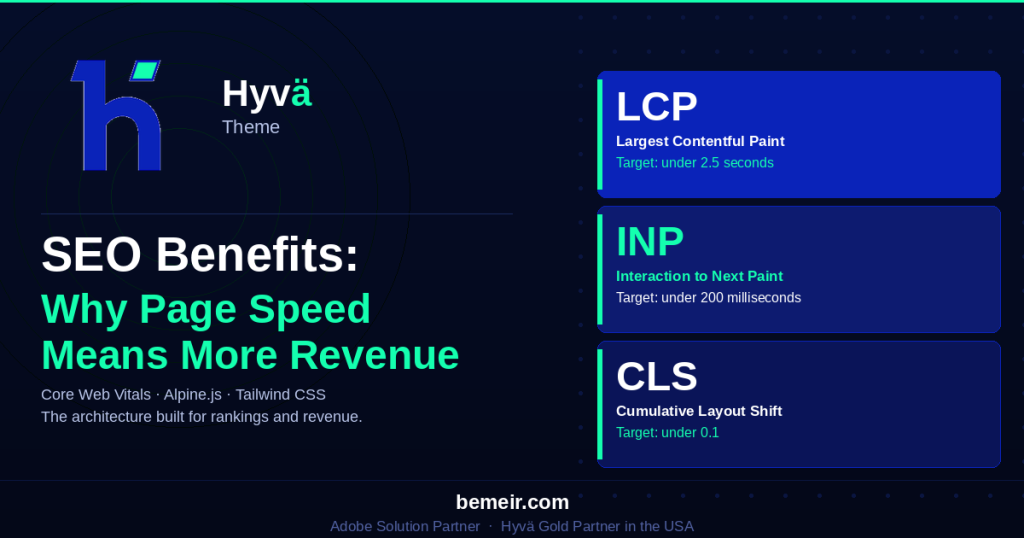
| Google’s Core Web Vitals — LCP under 2.5 seconds, INP under 200 milliseconds, and CLS under 0.1 — are direct ranking signals, per Google Search Central (December 2025). Passing all three requires a frontend that sends minimal JavaScript to the browser. Luma cannot achieve this. Hyvä is designed for it. |
| A one-second delay in page load time reduces eCommerce conversions by approximately 7%, per the Deloitte “Milliseconds Make Millions” study commissioned by Google (deloitte.com). A 0.1-second improvement in mobile load time increases retail conversion rates by 8.4% and average order value by 9.2%, per Google and Deloitte’s 2020 retail study, as reported on Google’s web.dev. |
| Bemeir’s client SD Bullion — a $1B GMV precious metals retailer — migrated to Hyvä with Bemeir and saw a 40% conversion lift. As the first and only Hyvä Gold Partner in the USA, Bemeir has run Hyvä migrations across B2C, B2B, and high-GMV stores. Hyvä Widgets, built by Bemeir, are used by 250+ Magento stores. |
| Bemeir is the first and only Hyvä Gold Partner in the USA and built Hyvä Widgets, used by 250+ Magento stores. A free site speed audit benchmarks your current Core Web Vitals and quantifies the revenue case before any migration decision. See bemeir.com/hyva/. |
1. The Luma Performance Problem, in Numbers
The performance gap between Luma and Hyvä comes from a single architectural difference: Hyvä removes Luma’s entire frontend JavaScript stack and replaces it with Alpine.js and Tailwind CSS, per the official Hyvä documentation at docs.hyva.io/hyva-themes/overview.html. Luma builds its interactivity on RequireJS, Knockout.js, and jQuery. Hyvä replaces all three. The result is pages that send a fraction of the JavaScript and CSS that Luma sends, which is why Hyvä stores routinely achieve Lighthouse scores above 90 on mobile, per mgt-commerce.com’s 2026 Hyvä guide.
The reason for this gap is architectural. Luma’s RequireJS module loader creates a waterfall effect: the browser parses each JavaScript file, identifies its dependencies, loads those dependencies, parses them in turn, and continues down the chain. HTTP/2 does not solve this because the bottleneck is sequential parsing, not parallel downloading. The browser cannot move forward until each step completes. The Core Web Vitals impact is direct: LCP is delayed because the browser cannot paint the main content while processing the script dependency graph, and INP degrades because the main thread is occupied executing scripts instead of responding to user input.
Hyvä eliminates RequireJS entirely, along with Knockout.js and jQuery. Alpine.js, which replaces all three, is inline and event-driven — it does not create a module loading waterfall. Tailwind CSS, which replaces LESS, generates only the utility classes used on a given page rather than shipping a complete stylesheet covering every possible component state. The result is a frontend that loads in a fraction of the time Luma requires, per the Hyvä documentation at docs.hyva.io/hyva-themes/overview.html.
| Metric | Luma (default) | Hyvä |
| Page requests | ~230 | ~5 |
| Page weight (uncompressed) | ~3MB | ~0.4MB |
| Requests reduction | — | 98% fewer |
| Page weight reduction | — | 86% lighter |
| Typical LCP on mobile | 4–8 seconds | 1–2.5 seconds |
| Typical Lighthouse score (mobile) | Below 70 | Above 90 |
Source: docs.hyva.io/hyva-themes/overview.html official documentation; mgt-commerce.com/blog/hyva-theme-guide/ (2026). Lighthouse scores based on production Hyvä migrations.
2. Core Web Vitals: What Google Measures and Why It Matters for Rankings
Google’s Core Web Vitals are three metrics that measure real-world user experience based on data collected from Chrome browsers. They are direct ranking signals — not proxies or indirect correlates — per Google Search Central (updated December 2025). Google’s March 2026 core update strengthened the weight of Core Web Vitals performance in its ranking algorithm, per Google Search Central (December 2025). The three metrics, and what they measure:
| Metric | Good | Needs Improvement | Poor |
| LCP (loading speed) | Under 2.5 seconds | 2.5 – 4.0 seconds | Over 4.0 seconds |
| INP (interactivity) | Under 200 ms | 200 – 500 ms | Over 500 ms |
| CLS (visual stability) | Under 0.1 | 0.1 – 0.25 | Over 0.25 |
Source: Google Search Central (developers.google.com/search/docs/appearance/core-web-vitals, December 2025). All three metrics must reach Good for a URL group to be rated Good in Google Search Console.
LCP: largest contentful paint
LCP measures how quickly the largest visible element on the page — usually the hero image or main product image — becomes visible. The Good threshold is under 2.5 seconds. Poor is over four seconds, per Google Search Central. LCP is the most-failed Core Web Vital: only 62% of mobile pages achieve a Good score, per the 2025 Web Almanac.
On a Luma store, LCP suffers because RequireJS’s waterfall loading delays content rendering. The browser must complete the dependency resolution process before it can paint the hero image. Per the Hyvä documentation at docs.hyva.io/hyva-themes/overview.html, the primary LCP optimization techniques on Hyvä are: preloading the LCP image with fetchpriority=”high”, lazy loading below-fold images so the browser stays focused on visible content, and deferring non-critical JavaScript so it does not compete for bandwidth during initial render. These optimizations work because Hyvä already sends minimal JavaScript — on Luma, the same techniques produce smaller gains because the underlying JS payload remains heavy.
INP: interaction to next paint
INP replaced First Input Delay (FID) as the responsiveness metric in March 2024. FID measured only the first interaction on a page. INP measures every interaction — every click, tap, and keypress — and takes the worst response at the 98th percentile as the store’s score, per Google Search Central (December 2025). The Good threshold is under 200 milliseconds. 43% of sites globally fail the 200-millisecond threshold as of 2026, per the 2025 Web Almanac.
Fixing poor INP requires reducing JavaScript on the main thread. This is what Hyvä does structurally. Alpine.js sends minimal JavaScript to the browser, which keeps the main thread clear for handling user interactions, per the Hyvä documentation at docs.hyva.io/hyva-themes/overview.html. The practical result: clicking Add to Cart on a Hyvä store responds immediately. On a Luma store under JavaScript load, the same click can stall while the main thread finishes executing Knockout.js bindings and RequireJS modules.
CLS: cumulative layout shift
CLS measures visual stability: how much visible content unexpectedly moves as the page loads. The Good threshold is under 0.1. CLS is the best-performing Core Web Vital overall: 81% of mobile pages achieve a Good score, per the 2025 Web Almanac. Common causes of CLS include images without defined dimensions, dynamically injected promotional banners, and web fonts that render at a different size than the fallback.
Hyvä’s defined CSS layout structure and pre-set element positioning reduces CLS by avoiding the JavaScript-driven DOM manipulation that causes elements to reflow after initial paint. Because Hyvä does not rely on Knockout.js rearranging the DOM during page load, elements render in their final position from the first paint, per the Hyvä documentation at docs.hyva.io/hyva-themes/overview.html.
Why passing all three Core Web Vitals matters — not just two
Google Search Console assigns a URL group’s status to its worst-performing metric. A URL group with Good LCP and Good INP but Poor CLS is rated Poor. All three metrics must pass the Good threshold for a URL to be rated Good. Per Google Search Console documentation, only URLs with sufficient field data for both LCP and CLS appear in the report. For a Magento store with thousands of product pages, the pages that are not indexed at all may be failing Core Web Vitals silently.
3. How Hyvä’s Architecture Addresses Each Metric
The performance improvements Hyvä delivers are not the result of optimization techniques applied after the fact. They are consequences of the architectural decisions built into the theme from the start, as documented at hyva.io and in the official Hyvä documentation (docs.hyva.io/hyva-themes/overview.html).
| Layer | Luma (default) | Hyvä replacement | Performance impact |
| Interactivity | Knockout.js — separate viewmodel layer, heavy dependency | Alpine.js — inline, event-driven, no module loader | Reduces INP and LCP |
| Module loading | RequireJS — waterfall of sequential HTTP requests | Removed entirely | Eliminates render-blocking |
| DOM manipulation | jQuery — additional library adding parse overhead | Removed entirely | Frees main thread |
| Styling | LESS — full compiled stylesheet for every page state | Tailwind CSS — only classes used on the page | Reduces CSS payload |
| Total JS/CSS overhead | Hundreds of requests, 3MB+ per page | Fraction of requests, <1MB per page | Passes Core Web Vitals |
Source: Official Hyvä documentation (docs.hyva.io/hyva-themes/overview.html); mgt-commerce.com/blog/hyva-theme-guide/ (2026).
Alpine.js replaces Knockout.js and jQuery
Alpine.js is a lightweight, declarative JavaScript framework that handles interactive behaviors directly in HTML markup without a separate viewmodel layer. It does not require a module loader and does not maintain a separate state graph that syncs with the DOM. It runs inline, handles the specific interaction defined, and does nothing more. Per the official Hyvä documentation (docs.hyva.io/hyva-themes/overview.html), this eliminates the RequireJS waterfall, resulting in a dramatically lighter JavaScript payload compared to Luma.
The INP benefit is direct: less JavaScript executing on the main thread means the browser responds faster to every user interaction across the entire session, not just the first click. The LCP benefit is equally direct: the browser can render the main content without waiting for a JavaScript dependency graph to resolve.
Tailwind CSS replaces LESS stylesheets
Luma ships large LESS-compiled CSS files covering every possible component state and page type across the entire store. Most of that CSS is irrelevant to any given page — the browser downloads and parses all of it regardless. Tailwind CSS, by contrast, generates only the utility classes that appear in the actual template code. The result is a CSS payload measured in kilobytes rather than hundreds of kilobytes, per the mgt-commerce.com 2026 Hyvä guide.
The SEO-relevant impact: smaller CSS files parse faster, unblocking the browser’s ability to render the page. Fewer render-blocking resources improve LCP directly. The absence of unused styles also means the page’s layout is defined precisely, reducing the risk of unexpected layout shifts that degrade CLS scores.
Fewer requests improve TTFB indirectly
Reducing the number of page requests from 230 to five does not directly improve Time to First Byte (TTFB), which is a server-side metric. But it reduces the total number of connections the browser must open after receiving the HTML, which reduces the total load time. Per docs.hyva.io/hyva-themes/overview.html’s Core Web Vitals documentation, server-side caching (Varnish for full-page cache, Valkey for session and object cache) handles TTFB directly — and that optimization is more effective when the frontend payload is minimal, because there is less to transfer once the first byte arrives.
Mobile-first performance
Google uses mobile scores as the primary ranking signal for all results, including desktop results, per Google Search Central (December 2025). Over 60% of Google searches happen on mobile as of 2026, per Statista’s 2026 global mobile search statistics. The performance conditions Google uses to benchmark mobile — a mid-range Android device on a 4G connection with CPU throttling — are the conditions under which Luma’s JavaScript payload performs worst. Hyvä’s minimal JavaScript sends far less to that throttled device, which is why the Lighthouse score gap between Luma and Hyvä is widest on mobile. A one-second page load delay reduces conversions by approximately 7%, per the Deloitte “Milliseconds Make Millions” study commissioned by Google (deloitte.com). That toll is steepest on mobile, where connection speeds are most variable.
4. SEO Benefits Beyond Core Web Vitals
Passing Core Web Vitals is the most direct performance-to-SEO connection, but faster Magento stores produce SEO benefits that extend beyond the ranking signal itself.
Crawl budget efficiency
Google allocates a crawl budget to each site: a limit on how many pages it will crawl and index within a given period. Faster page response times allow Google’s crawler to index more pages within that budget. For large Magento catalogs with thousands of product pages, category pages, and filtered views, TTFB directly determines how much of the catalog Google indexes.
A Luma store with a slow TTFB may have product pages that never appear in search results not because they are excluded from the sitemap but because Google’s crawler exhausts its budget before reaching them. A Hyvä store with a fast TTFB — supported by Varnish caching and PHP 8.4/8.5 FPM — allows the crawler to work through more pages per session. Faster page response times allow Google’s crawler to process more pages within the same crawl budget, per Google’s crawl budget documentation.
Reduced bounce rate from faster first paint
When mobile load time increases from one second to three seconds, the probability of bounce increases by 32%, per Google’s analysis of Chrome User Experience Report (CrUX) data. A bounce is a session where the visitor leaves without interacting with the page — and a high bounce rate signals to Google that visitors are not finding what the page promises.
Hyvä’s faster first paint — specifically, faster LCP — keeps visitors on the page long enough to interact. Stores with Good Core Web Vitals scores see on average 24% lower bounce rates than stores with Poor scores, per Google’s Chrome User Experience Report. Lower bounce rates improve engagement signals and compound the organic traffic benefit of the Core Web Vitals ranking improvement.
Structured data and semantic HTML
Hyvä’s clean HTML output, without the nested template markup that Luma generates for RequireJS module declarations, makes it easier to implement structured data markup correctly. Structured data — product schema, breadcrumb schema, review schema — enables rich results in Google Search (star ratings, price ranges, availability) that improve click-through rates without requiring ranking improvements. The cleaner DOM that Hyvä produces makes structured data implementation and validation more reliable, as documented in the official Hyvä documentation at docs.hyva.io/hyva-themes/overview.html.
Organic traffic compounding after Core Web Vitals pass
Sites that pass Core Web Vitals after previously failing see measurable organic traffic gains from the improved ranking signal, per Google Search Central (December 2025). That traffic increase, combined with the higher conversion rate that comes from faster load times, produces a compounding revenue effect: more visitors arriving and a higher percentage of them completing purchases. The conversion multiplier applies to every organic session, every paid session, and every direct session, not just those from Core Web Vitals-influenced queries.
5. What Hyvä Migrations Actually Deliver: Bemeir’s Experience
The performance case for Hyvä is well-documented in the official Hyvä case study directory at hyva.io/agency/hyva-case-studies. Bemeir’s own client work adds US-specific context to that picture.
SD Bullion: 40% conversion lift on a $1B GMV store
Bemeir’s client SD Bullion — a precious metals retailer processing over $1 billion in annual GMV — migrated to Hyvä with Bemeir and saw a 40% lift in conversion rate. SD Bullion operates in one of the most performance-sensitive eCommerce categories: real-time pricing, high-value checkout transactions, and a buyer base that compares prices across tabs in real time. Checkout latency and page responsiveness are not background metrics for this store — they are directly tied to whether a buyer completes a transaction or refreshes a competitor’s price first. The Hyvä migration addressed both: faster page loads reduced friction between price discovery and purchase, and improved Core Web Vitals scores supported the organic search visibility the store depends on for traffic.
SD Bullion’s scale makes the result meaningful. A 40% conversion lift on a $1B GMV store translates to material revenue impact from the same traffic. Bemeir is an Adobe Solution Partner and the first and only Hyvä Gold Partner in the USA. For Hyvä migration services in detail, see bemeir.com/hyva/.
Hyvä Widgets: performance infrastructure used by 250+ Magento stores
Bemeir built Hyvä Widgets, now used by 250+ Magento stores. The Widgets extend Hyvä’s page-building capability with additional UI components built on Alpine.js and Tailwind CSS — maintaining Hyvä’s performance principles rather than reintroducing the JavaScript overhead that Hyvä was designed to eliminate. The adoption of Hyvä Widgets across 250+ stores reflects both the ecosystem gap and Bemeir’s direct contribution to closing it.
For a deeper look at the architectural advantages and B2B capabilities of this framework, you can explore Bemeir’s technical insights in our guide, Hyvä Frontend: The Ultimate Framework for High-Performance, Streamlined Magento B2B Experiences. Additionally, to understand the fundamental performance gap between legacy and modern frontend architectures, see our comparison in Hyvä vs Luma Magento: Why More Merchants Are Moving Away from Luma, or get a comprehensive technical overview in Unraveling the Depths of Hyva.
6. What Hyvä Does Not Fix on Its Own
The performance gains Hyvä delivers depend on the hosting and server configuration beneath it. As the Hyvä documentation at docs.hyva.io/hyva-themes/overview.html notes, frontend optimization produces its maximum benefit only when the server stack matches it.
TTFB is a server-side metric
Time to First Byte is determined by the server, not the frontend. A slow TTFB degrades LCP regardless of how light Hyvä’s pages are, because the browser cannot begin rendering until it receives the first byte of the HTML response. Varnish full-page caching is the primary tool for reducing TTFB on a Magento store. Without it, Hyvä’s frontend performance improvement has a ceiling set by server response time.
Required server stack
Per the Hyvä documentation (docs.hyva.io/hyva-themes/overview.html) and mgt-commerce.com’s 2026 Hyvä guide, the following server-side components must be correctly configured for Hyvä to deliver its performance ceiling. Magento 2.4.9, current as of May 2026, requires PHP 8.4 or 8.5 — PHP 8.2 was dropped entirely, and PHP 8.3 is supported only for upgrade compatibility, not new builds. Magento 2.4.9 also moved to Valkey 8 as the default cache backend, replacing Redis after Redis’s 2024 license change; Valkey remains wire-compatible with Redis. Search runs on OpenSearch 3.x, which changed index format from the 2.x line.
| Component | Role | Core Web Vitals impact |
| PHP 8.4 or 8.5 | Application runtime (8.2 dropped entirely in Magento 2.4.9; 8.3 for upgrade compatibility only) | Faster PHP execution reduces server response time and TTFB, which directly improves LCP |
| Varnish (full-page cache) | Caches full HTML responses at the server layer | Reduces TTFB to single-digit milliseconds for cached pages — the single biggest TTFB improvement available |
| Valkey 8 (session + object cache) | Caches session data and application objects in memory; default cache backend since Magento 2.4.9, wire-compatible with Redis | Reduces database load and backend response time, supporting faster TTFB |
| OpenSearch 3.x | Search engine for Magento 2.4.9 (Elasticsearch not recommended; 3.x index format differs from 2.x) | Slow catalog search responses degrade perceived LCP on search and category pages |
| Third-party script management (e.g. Partytown) | Runs analytics, chat, and ad pixels in a web worker off the main thread | Prevents third-party scripts from degrading INP and LCP on a Hyvä store |
Sources: Hyvä documentation — docs.hyva.io/hyva-themes/overview.html; Varnish — varnish-software.com; Partytown — partytown.builder.io; Magento requirements — experienceleague.adobe.com; mgt-commerce.com/blog/hyva-theme-guide/ (2026).
- PHP 8.4 or 8.5: PHP version directly affects execution speed. PHP 8.4/8.5 with FPM process management produces the fastest response times. PHP 8.2 was dropped entirely in Magento 2.4.9; PHP 8.3 remains supported only for upgrade compatibility, not for new builds.
- Varnish full-page cache: Reduces TTFB to single-digit milliseconds for cached pages. Without Varnish, every page request hits PHP, which adds hundreds of milliseconds to TTFB and, consequently, to LCP.
- Valkey: Handles session cache and object cache. Valkey replaced Redis as Magento’s default cache backend after Redis’s 2024 license change; Valkey is wire-compatible with Redis, so existing Redis-based configurations migrate with minimal changes. Reduces the database load that contributes to backend response time.
- OpenSearch 3.x: Required for Magento 2.4.9 as the search engine. The 3.x index format differs from the 2.x line, so search indexes must be rebuilt on upgrade. Slow catalog search responses contribute to perceived page load time on search results and filtered category pages.
- Third-party script management: Google Tag Manager, analytics platforms, live chat widgets, and advertising pixels load on the browser’s main thread and can degrade INP and LCP even on a Hyvä store. The Hyvä documentation recommends tools like Partytown to run third-party scripts in a web worker, isolating their performance impact from the main thread.
The Hyvä performance paradox
A Hyvä store with unoptimized third-party scripts, a missing Varnish cache, or large uncompressed images can still fail Core Web Vitals. Hyvä removes the frontend bloat that makes passing Core Web Vitals structurally impossible on Luma. It does not remove every other source of slowness. Per the Hyvä documentation at docs.hyva.io/hyva-themes/overview.html, the full performance gain requires both the Hyvä frontend and a correctly configured server stack underneath it.
7. Calculating the Revenue Impact
The connection between page speed and revenue is well-documented and calculable for specific stores. The inputs required are: current annual revenue, current mobile load time (measurable via Google PageSpeed Insights at no cost), and current Core Web Vitals status in Google Search Console.
The conversion rate calculation
Google and Deloitte’s “Milliseconds Make Millions” study of 37 major retail websites found that a 0.1-second improvement in mobile page load time increased retail conversion rates by 8.4% and average order value by 9.2% (deloitte.com; also at web.dev/case-studies/milliseconds-make-millions). A Hyvä migration from Luma typically reduces mobile load time by one to three seconds on a store that was running a default Luma installation.
The broader dataset is consistent with the Deloitte finding. Every 100 milliseconds of load time costs approximately 1% in conversions, per Google’s web.dev performance research at web.dev/performance. The compounding effect of multiple small improvements — faster LCP, lower INP, reduced CLS — means that a well-executed Hyvä migration typically produces a larger combined lift than any single metric improvement in isolation.
The bounce rate calculation
The Google and Deloitte “Milliseconds Make Millions” study (deloitte.com) establishes the core figures: a 0.1-second improvement in mobile load time increases conversion rates by 8.4% and average order value by 9.2%; a one-second delay in the opposite direction reduces conversions by 7%. These are measured outcomes from 37 major retail websites, not projections.
The bounce rate relationship compounds the conversion effect. When mobile load time increases from one second to three seconds, the probability of bounce increases by 32%, per Google’s Chrome User Experience Report data. Fewer visitors reaching the product page means fewer opportunities to convert, regardless of how well the product page itself performs.
The search ranking benefit
Passing Core Web Vitals after previously failing brings an additional organic traffic benefit on top of the conversion rate improvement. Sites that fix failed Core Web Vitals see measurable organic traffic gains from the improved ranking signal, per Google Search Central (December 2025). Stores with Good Core Web Vitals scores show 24% higher mobile conversion rates than stores with Poor scores, per Google CrUX field data.
The compounding effect is what makes a Hyvä migration different from a one-off optimization. A faster store converts more of its existing traffic, attracts more organic traffic through improved rankings, and retains more visitors through lower bounce rates — all simultaneously, on every session, across every channel.
8. Frequently Asked Questions
Does switching to Hyvä automatically improve Google rankings?
Not automatically — but in practice, yes for most Magento stores on Luma. Core Web Vitals are a direct ranking signal, and most Luma stores fail at least one threshold. Passing all three on Hyvä improves the ranking signal for every page on the site. Google evaluates Core Web Vitals data over 28-day windows per Google Search Console documentation, so ranking movement typically follows within 30 to 90 days of a clean Hyvä launch.
How much faster is Hyvä than Luma?
Hyvä pages load a fraction of the requests and page weight that Luma sends, because Alpine.js and Tailwind CSS replace Luma’s entire frontend stack, per the official Hyvä documentation (docs.hyva.io/hyva-themes/overview.html). Typical LCP on mobile drops from four to eight seconds on Luma to one to 2.5 seconds on Hyvä. Lighthouse scores above 90 on mobile are typical for well-built Hyvä stores, per mgt-commerce.com’s 2026 Hyvä guide. Absolute improvement depends on catalog size, extension load, and hosting.
What are the Core Web Vitals thresholds for 2026?
Per Google Search Central (December 2025): LCP under 2.5 seconds is Good; over four seconds is Poor. INP under 200 milliseconds is Good; over 500 milliseconds is Poor. CLS under 0.1 is Good; over 0.25 is Poor. All three must reach Good for a URL group to be rated Good in Google Search Console. Failing any one metric pulls the group’s status to Poor.
Why is INP more important than FID was?
FID measured only the first user interaction. INP measures every interaction — every click, tap, and keypress — and scores the worst response at the 98th percentile, per the 2025 Web Almanac. A fast first click and an 800-millisecond form submit: FID rates that as Good, INP rates it as Poor. Fixing poor INP requires reducing JavaScript on the main thread, which is exactly what Hyvä does by replacing RequireJS and Knockout.js with Alpine.js.
Can I improve Core Web Vitals on Luma without migrating to Hyvä?
Yes, but with a structural ceiling. Image optimization, Varnish caching, and JavaScript deferral all improve Core Web Vitals on Luma — but they work against hundreds of JavaScript dependencies loading by default. Reaching Lighthouse scores above 90 on Luma is not achievable because the RequireJS waterfall prevents it regardless of how aggressively other optimizations are applied. Hyvä removes that structural constraint, which is why the same optimizations produce better results on Hyvä than on Luma.
How long does a Hyvä migration take and what does it cost?
Per mgt-commerce.com’s 2026 Hyvä guide, a mid-market store should plan four to eight weeks and approximately $15,000 to $70,000 in development depending on catalog complexity and extension count. The Hyvä core theme is free and open source since November 10, 2025, per the official announcement at hyva.io/blog/news/hyva-is-free-open-source.html. The primary cost driver is extension compatibility: storefront-facing extensions need compatibility modules or custom rewrites before the theme can launch.
What is the revenue payback period for a Hyvä migration?
It depends on current annual revenue, current load time, and Core Web Vitals status. For a store generating $2 million or more annually where organic search is a primary traffic channel, the combination of higher conversion rates and more organic traffic typically produces a payback period measured in months, not years. The free site speed audit at bemeir.com/hyva/ benchmarks your current scores and calculates the revenue case before any migration commitment.
| Find Out What Slow Pages Are Costing Your Store. |
| Bemeir is the first and only Hyvä Gold Partner in the USA — and built Hyvä Widgets, used by 250+ Magento stores. |
| A free site speed audit benchmarks your Core Web Vitals and quantifies the revenue case for a Hyvä migration before you commit to anything. |
| Schedule a 30-minute discovery call — or request a free site speed audit. |
| bemeir.com/hyva/ • bemeir.com/magento/ • (212) 401-1969 |